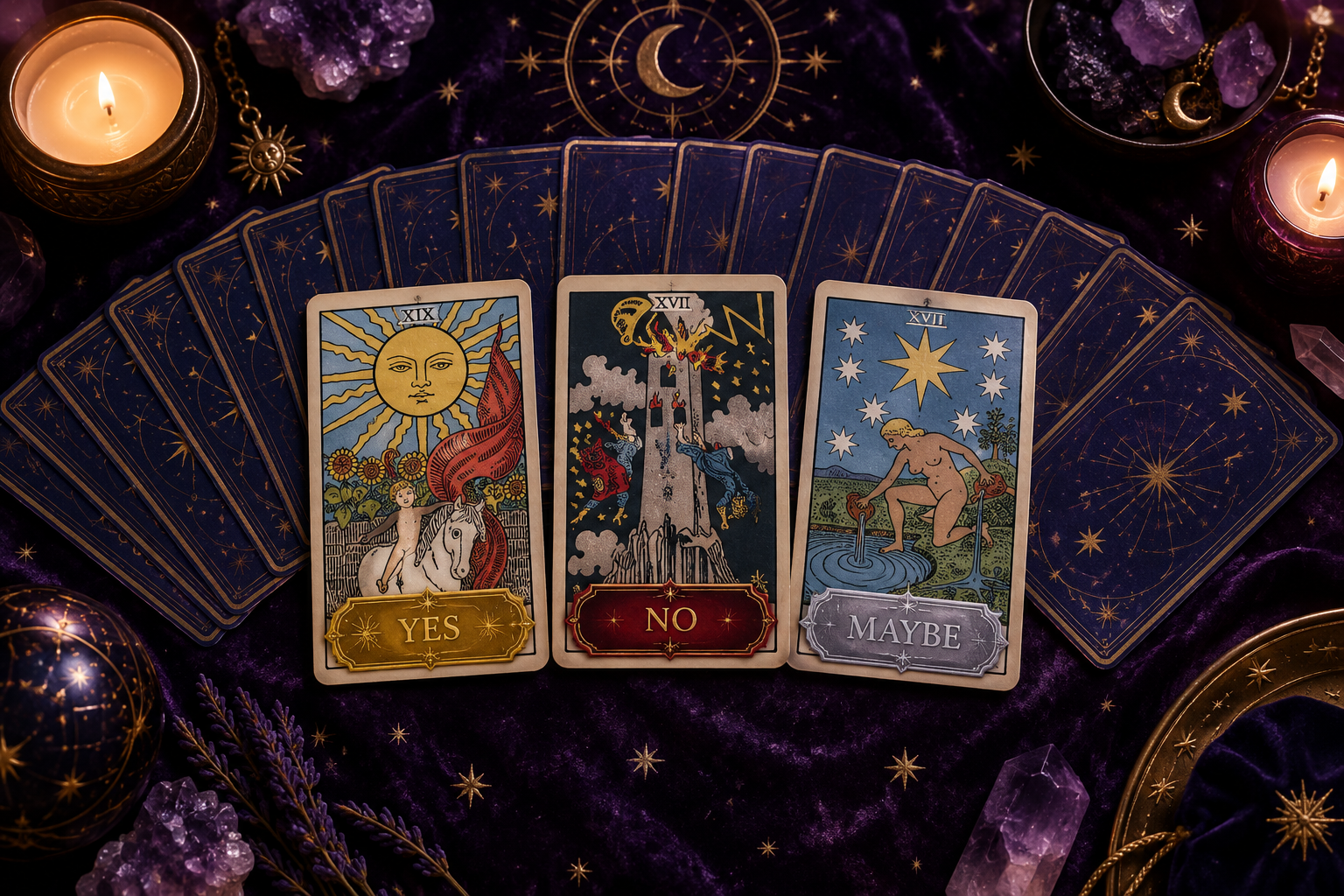

Justice is one of the few tarot cards where the answer genuinely depends on you. Upright, it leans yes, but only when your conduct can stand up to scrutiny. Reversed, it says no, or more often “not yet,” because something in the situation is still out of balance.
Quick answer
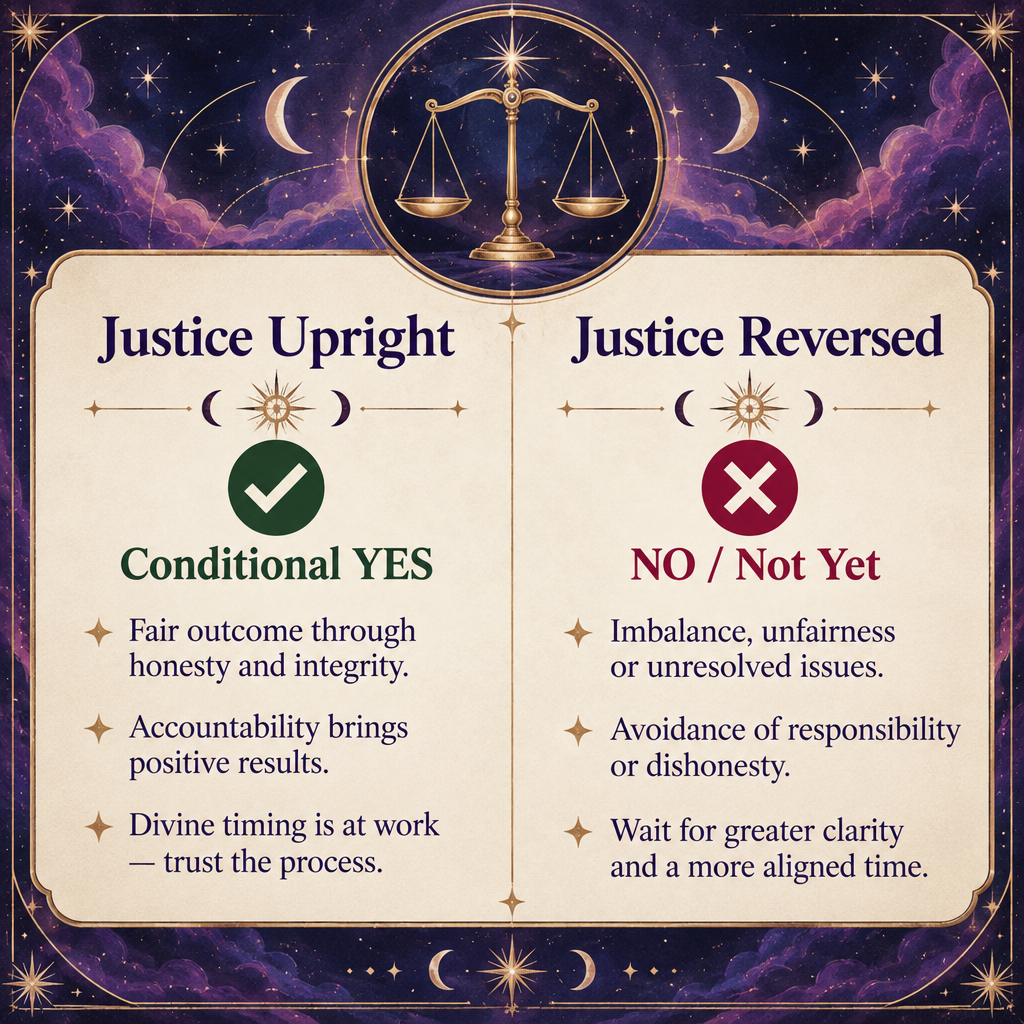
Justice upright: Conditional Yes. The outcome will be fair, which is good news if you’ve acted with integrity and uncomfortable news if you haven’t.
Justice reversed: No / Not yet. Expect delay, bias, or an unfair result until the imbalance is corrected.
Best for: legal questions, contracts, settlements, decisions that require weighing evidence.
Weakest for: questions that need passion, speed, or luck rather than fairness.
Justice at a Glance
| Attribute | Detail |
|---|---|
| Arcana | Major Arcana, card XI (card VIII in Thoth and Marseille decks) |
| Element | Air |
| Zodiac sign | Libra |
| Ruling planet | Venus (through Libra) |
| Numerology | 11, reducing to 2 (balance, partnership, duality) |
| Yes or no | Conditional yes upright; no or not yet reversed |
| Keywords | Fairness, truth, cause and effect, accountability, law, balance, clarity |
| Timing | Slow and deliberate; Libra season (roughly 23 September to 22 October) |
Why Justice Is a “Maybe” Rather Than a Flat Yes
Most beginners want Justice to be a clean yes card like The Sun or The Star. It isn’t. The card promises a correct outcome, not a pleasant one. If you ask “Will I get the promotion?” and you’ve been coasting while a colleague has carried the team, Justice upright still says the result will be fair. That means the colleague gets it.
This is why experienced readers call Justice a conditional yes. The condition is your own behaviour and the honesty of your position. Ask yourself whether a neutral third party, looking at every fact including the ones you’d rather hide, would rule in your favour. If so, Justice upright is a yes. If you’re hoping nobody looks too closely, it’s a warning dressed as a yes.
Reversed Justice doesn’t flip to a permanent no. It flags that the scales are tilted right now. The tilt might be your fault, someone else’s, or a system that’s broken. Fix what you can and the answer can change, which is why “not yet” is the more accurate reading than a hard no.
What the Symbols Tell You About the Answer
The Rider-Waite-Smith image is unusually direct, and each element maps onto the yes/no meaning.
The scales in the figure’s left hand represent cause and effect. Whatever you put on one side gets weighed against what you put on the other. For a yes/no question, the scales say the result will match the input. Honest effort produces a yes. Cut corners and the same scales produce a no.
The upright sword in the right hand stands for truth and the clarity to act on it. It’s double-edged on purpose: truth cuts both ways, and the person holding it has to be prepared to lose as well as win. When Justice appears, hidden facts tend to surface. If your question depends on something staying buried, that’s your answer.
The seated, robed figure sits between two pillars with no blindfold. Unlike the modern statue of blind justice, this Justice sees everything and still remains impartial. She has no stake in your preferred outcome. That neutrality is the whole point of the card: it won’t bend the result in your favour because you want it badly.
The red robe and green mantle combine Venus (harmony, the green) with action (the red). Fairness here isn’t passive. Someone has to decide, sign, rule, or act. Justice is a yes that comes through a decision, not through drift.
Justice Yes or No in Love
Love questions are where Justice gets misread most often. People want it to mean “destined.” It means “fair,” which is different and in many ways more useful.
Existing relationships
Upright: Yes, provided the relationship is reciprocal. Justice confirms that both people are contributing and that honesty is intact. If you’re asking “Will we stay together?” and you’re both showing up, this is a solid yes. If you’re asking “Is my partner being faithful?” and the card appears upright, the honest answer is that the truth will come out either way, and you’ll have the clarity to act on it.
Reversed: No, not in the current form. Reversed Justice in a committed relationship points to one-sided effort, a double standard, or one partner quietly changing the rules without saying so. A classic example: one person keeps a mental ledger of everything they do while the other feels judged by criteria they never agreed to. The relationship can recover, but not without an honest reckoning about what each person actually owes the other.
New relationships
Upright: Yes, if you’re being genuine. Justice favours connections that start on an even footing. Nobody is exaggerating their job, their availability, or their intentions. For “Will this become something serious?” the card says it has a fair chance, and your truthfulness in the early weeks sets the terms.
Reversed: Proceed carefully. Someone is misrepresenting something, or the two of you want very different things and one party hasn’t said so. It’s not a dramatic no, but it’s a strong prompt to ask the awkward questions now rather than six months in.
Reconciliation with an ex
Upright: Usually no. This surprises people. Upright Justice tends to confirm that the relationship ended for valid reasons and that the ending was, in the card’s view, fair. Reopening it would mean overturning a verdict that was correct. The exception is when the breakup itself was unjust: a misunderstanding, interference from a third party, or one person leaving without the full facts. In that narrow case, Justice can support a second look.
Reversed: Unresolved, which is not the same as reconcilable. Someone still feels wronged and wants acknowledgment. Getting that closure matters. Getting back together is a separate question, and reversed Justice doesn’t endorse it.
Justice as feelings
When Justice represents how someone feels about you, upright means they see you as fair, principled, and worth taking seriously. The feeling is respect-based rather than infatuation. They’re weighing you carefully, which is a good sign if you want something durable and a frustrating one if you want fireworks.
Reversed as feelings means the person believes something between you is unfair or unfinished. They may feel they gave more than they received, or that they were judged harshly. Until that sense of imbalance is addressed, their feelings stay guarded.
Justice Yes or No in Career
Upright Justice in career questions is a yes rooted in track record. The card says your results, reputation, and conduct are what will decide the matter, and that the decision will reflect them accurately. If you’ve been reliable, the yes is reliable too.
Justice is at its strongest for anything involving paperwork and formal agreements:
- Signing an employment contract or offer letter
- Negotiating terms, salary bands, or severance
- Partnership agreements, licensing, and non-compete clauses
- Performance reviews conducted against stated criteria
- Workplace grievances handled through a proper process
For questions like “Should I sign this contract?” an upright Justice is close to the best card you can draw. It indicates the terms are balanced and the other party is dealing straight. Read the document anyway. The card rewards diligence, not blind trust.
Reversed Justice at work is a not yet. Common scenarios include being passed over because of office politics, taking the blame for a shared failure, or being held to a standard that shifts whenever you meet it. Sometimes the imbalance is internal: the card can also show up when you’re underperforming and attributing it to everyone but yourself.
Corrective steps that tend to shift a reversed Justice:
- Document everything. Decisions, deadlines, who agreed to what. Fairness is easier to demand when there’s a record.
- Ask for criteria in writing before you’re evaluated against them.
- Own your part of any failure before pointing at anyone else’s.
- If the system itself is biased, use the formal channel (HR, a union, a regulator) rather than hoping it self-corrects.
Justice Yes or No in Legal Matters
This is the card’s home ground. Justice literally depicts a judge, and for questions about court cases, disputes, arbitration, and contracts it carries more weight than in any other area.
Upright: Yes, with the same condition as always. The process will be fair and the facts will be heard. If you’re the party in the right, with documentation and a legitimate claim, Justice upright is a positive omen for:
- Winning or favourably settling a lawsuit
- A fair divorce or custody ruling
- Insurance claims being honoured
- A contract being upheld as written
- A grievance or appeal being decided on merit
If you’re hoping to win on a technicality while the substance of the case is against you, the card is telling you the substance will matter. Readers who draw Justice upright and later lose almost always find, on reflection, that they were asking the card to validate a weak position.
Reversed: No, or significant complications. Reversed Justice in a legal question points to bias, procedural delays, a corrupt or incompetent process, missing evidence, or an opponent who is not playing fair. It can also indicate that your own case has a hole in it you haven’t acknowledged. Practical response: get better representation, shore up your documentation, and consider whether settlement beats a drawn-out fight you’re not positioned to win.
Justice Yes or No in Finances
Money questions and Justice go together because so many financial situations are, at bottom, about what is owed.
Upright: Yes for anything involving a fair exchange or the return of what’s rightfully yours.
- Money you lent will be repaid, or a debt you owe will be settled on reasonable terms
- A refund, deposit, or insurance payout comes through
- An inheritance or settlement is divided equitably
- A tax matter resolves correctly, which cuts both ways if you’ve been under-reporting
- A financial agreement (loan, lease, investment) has balanced terms
For “Will I get my money back?” upright Justice is a yes. For “Will I win big?” it’s a shrug. The card has nothing to do with windfalls. It deals in what’s earned and what’s due.
Reversed: No, for now. Expect disputes over who owes what, an unfair split, a payment that stalls, or a contract with terms stacked against you. Reversed Justice also appears when your own finances are out of balance: spending that doesn’t match income, or debt that’s being ignored rather than managed. The remedy is unglamorous. Get the numbers in front of you, put agreements in writing, and pursue what you’re owed through formal channels if informal ones have failed.
Justice Yes or No for Health
Upright: Yes, in the sense that balance supports recovery and a correct diagnosis is on its way. Justice in a health reading favours moderation over extremes: steady sleep, consistent movement, a sustainable diet rather than a crash plan. It also suggests you’ll get a clear, accurate answer from medical professionals, which makes it a good card to see when you’re waiting on test results or a second opinion.
Reversed: No, not until the imbalance is addressed. Reversed Justice points to a lifestyle where one area is being overfed at the expense of another. Overwork and no rest. A strict regime that collapses into bingeing. Ignoring a symptom because dealing with it is inconvenient. The card isn’t predicting disaster. It’s saying the body keeps its own ledger, and the current pattern won’t pass an honest audit. None of this replaces a doctor. Tarot is a prompt for reflection, not a diagnosis.
Timing: How Long Will It Take?
Justice is slow. Libra is the sign of deliberation, and the card describes a process where every factor gets weighed before anything is decided. If you’re asking “When?”, the honest answer is “after everything has been considered,” which in practice means weeks or months rather than days. Legal timelines, formal reviews, and settlement negotiations all move at this pace.
Readers who work with astrological timing associate Justice with Libra season, 23 September to 22 October, and sometimes with periods when Venus is prominent. Reversed Justice stretches the timeline further, usually because something is being contested or evidence is missing.
The upside of slow timing is that the result tends to hold. Fast decisions get reversed. Decisions made after Justice has done its weighing usually stick.
How Justice Differs From Similar Cards
People often confuse Justice with other balance-and-decision cards. The differences matter for a yes/no reading.
| Card | Yes or no | How it differs from Justice |
|---|---|---|
| The Lovers | Yes | A yes based on alignment and desire, not merit. The Lovers says “this is a good match.” Justice says “this is a fair deal.” |
| Wheel of Fortune | Yes | A yes based on luck and cycles turning. You didn’t necessarily earn it. Justice’s yes is always earned. |
| The Empress | Yes | Abundant, generous, unconditional. The Empress gives more than is owed. Justice gives exactly what is owed. |
| The High Priestess | Maybe | A maybe because the answer is hidden. Justice’s maybe exists because the answer depends on your conduct, not on secrecy. |
| Judgement | Yes | A reckoning followed by renewal. Judgement is a final call. Justice is the hearing before the call. |
| Temperance | Yes | Balance through blending and patience. Temperance soothes. Justice rules. |
If Justice shows up alongside The Lovers, the relationship is both wanted and fair, which is about as good as it gets. Justice next to Wheel of Fortune suggests the outcome is still being decided and could tip either way. Justice next to the Seven of Swords is a strong signal that dishonesty is about to be exposed.
Self-Assessment: Turning the Card Into a Real Answer
Because Justice’s verdict depends on your position, these questions will sharpen it. Answer them honestly, in writing if you can.
- If every relevant fact about this situation were laid out for a neutral stranger, what would they conclude? Not what you’d argue. What they’d conclude.
- What have you contributed to this outcome, and what have you been expecting without contributing?
- Is there anything you’re hoping stays hidden? If so, assume it won’t.
- Where are you applying a standard to someone else that you aren’t applying to yourself?
- What’s the one concrete action that would make your position fairer by this time next week?
If your answers hold up, read upright Justice as a confident yes and reversed Justice as a temporary delay. If they don’t, both positions are telling you the same thing: fix the imbalance first, then ask again.
FAQ
Is Justice a yes or no card?
Justice is a conditional yes. Upright, it indicates a fair outcome, which is a yes when your conduct and position are sound. Reversed, it means no or not yet, because the situation is currently unbalanced.
What does Justice reversed mean in a yes or no reading?
Reversed Justice means no for now. It points to unfairness, delay, bias, or an imbalance that has to be corrected before the answer can change. Treat it as “not yet” rather than “never,” and look for what’s out of alignment.
Does Justice mean yes in love?
Upright, yes, when the relationship is honest and reciprocal. For new relationships it’s a yes conditional on being genuine. For getting back with an ex, upright Justice usually says the ending was fair and shouldn’t be reopened.
Does Justice mean I will win my court case?
Upright Justice is a positive omen for legal matters and suggests the process will be fair and your evidence will be heard. It favours the party in the right. If your case is weak on substance, the card indicates that weakness will be exposed. Reversed Justice signals complications, bias, or delays.
Is Justice a good card for money questions?
Yes for debts being repaid, settlements being fair, and refunds or payouts coming through. It’s neutral on windfalls. Reversed, expect financial disputes or terms stacked against you.
What does Justice mean for health yes or no?
Upright is a yes for recovery through balance and moderation, and for getting an accurate diagnosis. Reversed is a no until lifestyle imbalances are addressed. Always consult a medical professional for actual health decisions.
Why is Justice number 11 in some decks and 8 in others?
The Rider-Waite-Smith tradition swapped Justice and Strength so the cards aligned with the zodiac order (Leo for Strength, Libra for Justice). Older Marseille decks and the Thoth deck keep Justice at VIII. The yes/no meaning doesn’t change with the number.