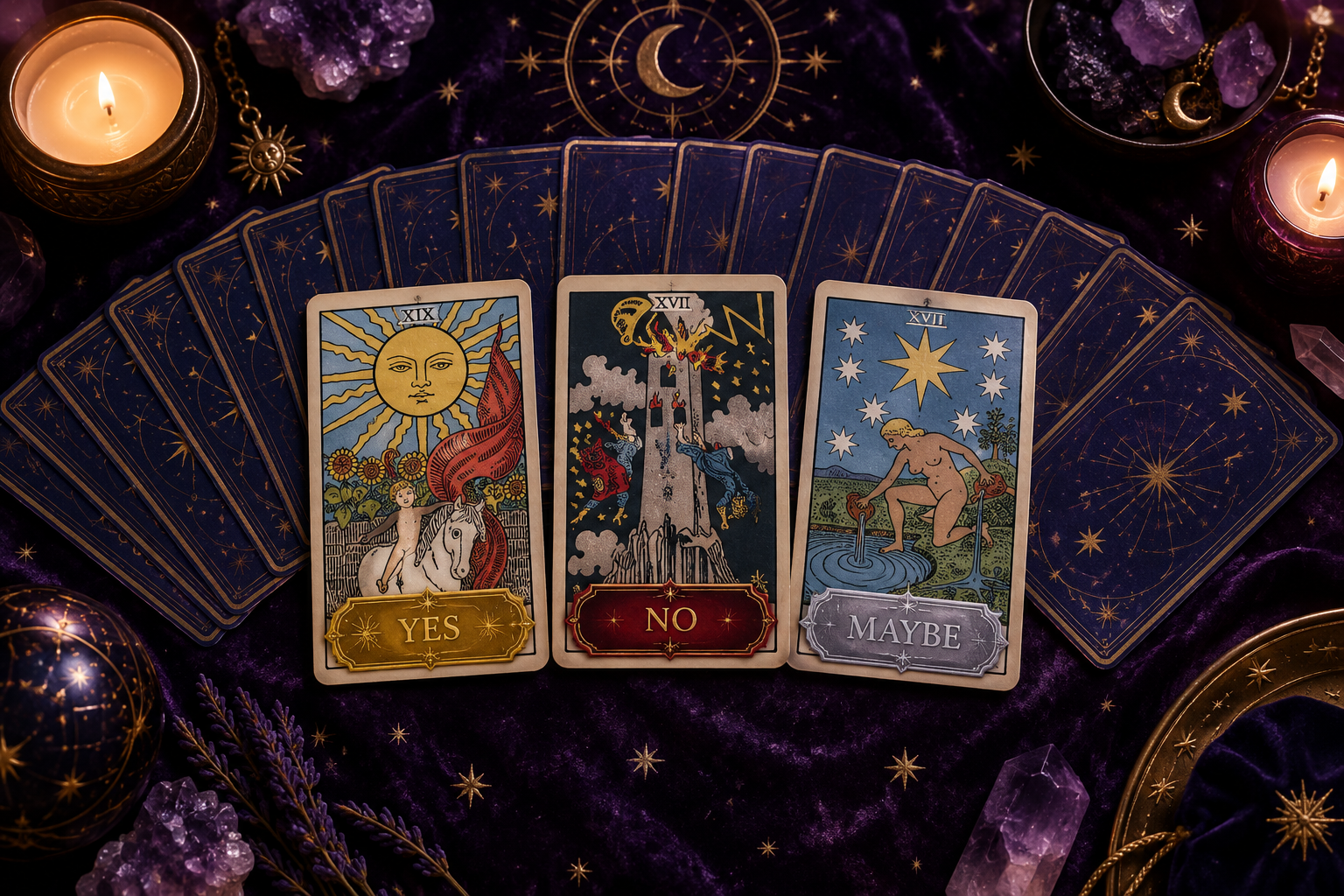
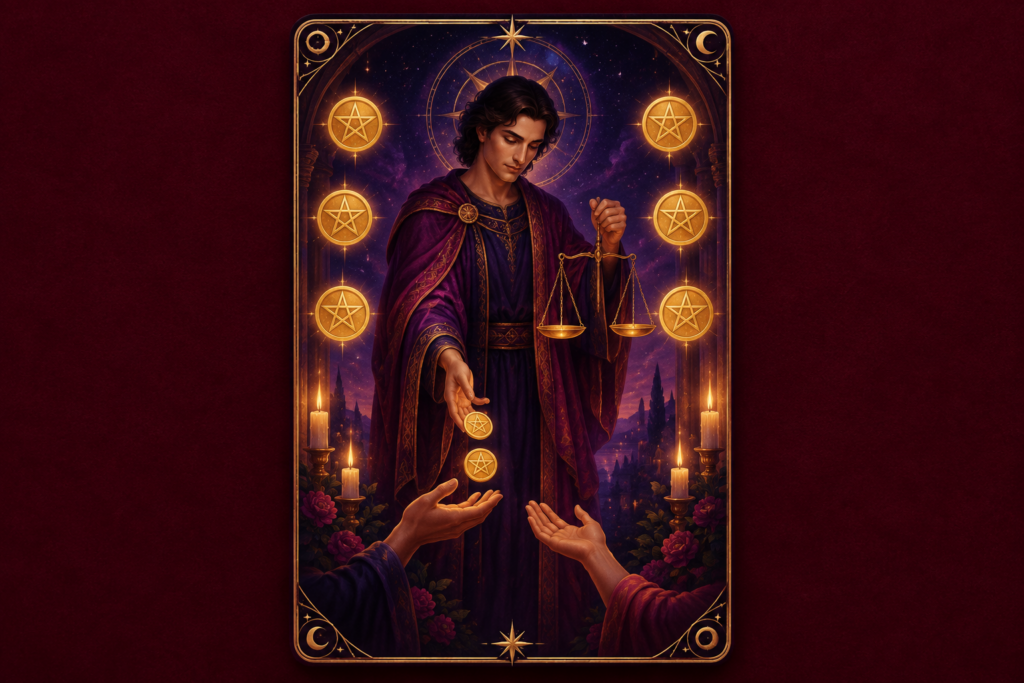
When the Six of Pentacles turns up in a feelings position, the person you are asking about feels like a giver toward you, and the real question is whether that giving is warm and freely offered or measured and conditional. Upright, they feel protective, generous and quietly committed. Reversed, they are keeping score, and you need to know which side of the ledger you are on.
The Card in One Look
The Six of Pentacles belongs to the Suit of Pentacles in the Minor Arcana, the suit of money, work, the body and anything you can touch. Sixes across the deck mark a moment of resolution after the struggle of the Fives, so this card describes feelings that have settled into something practical: the urge to provide, to help, to make another person’s life easier.
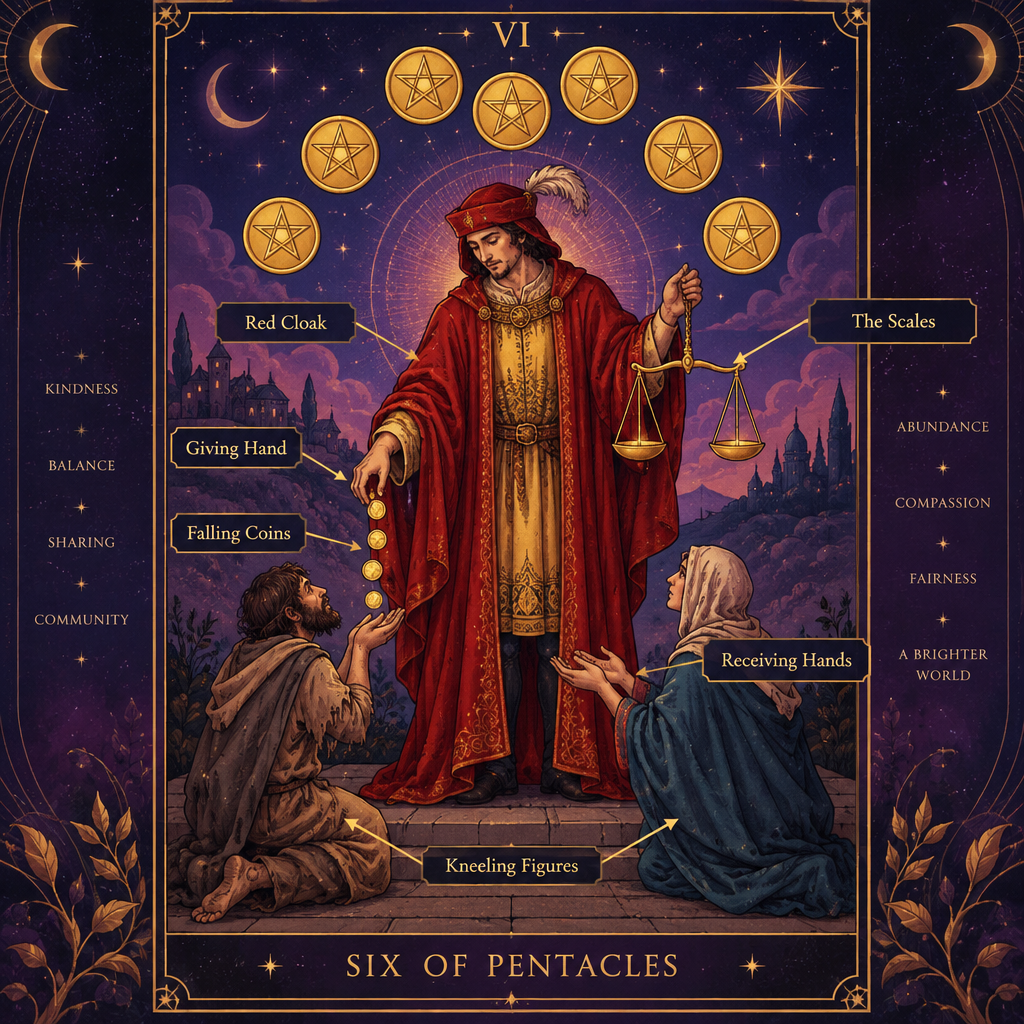
In the Rider-Waite-Smith image, a wealthy man in a red cloak holds a set of scales in his left hand and drops coins into the palm of a kneeling beggar with his right. A second beggar waits, hands open, receiving nothing yet. Six pentacles float above the scene. Every element of that picture maps onto how someone feels about you.
What Each Symbol Says About Their Feelings
| Symbol | What it means about how they feel toward you |
|---|---|
| The scales | They are weighing the relationship. Even when feelings are warm, there is a part of them assessing fairness, effort and what each of you brings. |
| The coins falling | They want to give you something concrete: time, money, attention, practical help. Their love shows up as action, not speeches. |
| The giving hand | They feel capable and secure around you, and they like that feeling. Being the one who provides is part of how they experience affection. |
| The receiving hands | They see you as someone who needs them, or they hope you do. Pay attention to whether that reads as tenderness or as a need to be needed. |
| The kneeling figures | There is a height difference in the picture. Someone is up and someone is down. In feelings readings, this is the hint that status or dependence colours the connection. |
| The red cloak | Red is the colour of desire and vitality in this deck. Their generosity is not cold charity; there is real warmth and attraction underneath it. |
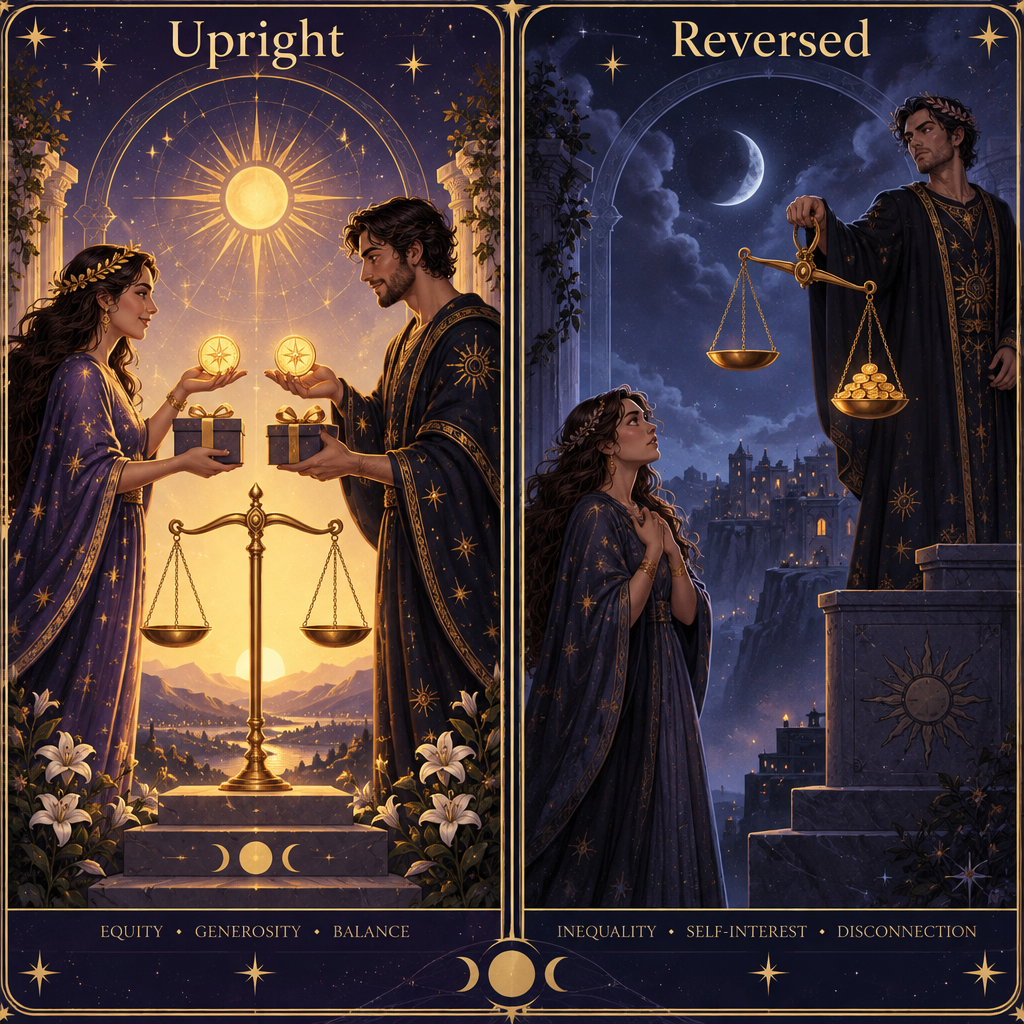
Modern decks keep the message but soften the hierarchy. The Light Seer’s Tarot shows the exchange as a shared, glowing gesture between equals, which is a useful corrective: the healthiest expression of this card is giving that does not look down.
Moon in Taurus
The Golden Dawn system assigns the Six of Pentacles to the Moon in the second decan of Taurus. Emotionally, that pairing describes someone whose feelings move slowly, root deeply and express themselves through comfort and security. A Moon in Taurus heart does not say “I love you” in the first week. It cooks for you, fixes your car, remembers how you take your coffee, and keeps doing that for years. If you are waiting for a grand declaration from this person, you are reading the wrong signals. Watch what they do for you.
Six of Pentacles Upright as Feelings
How a Crush or New Interest Feels About You
They have noticed you, and their instinct is to look after you. Upright, this card for a crush means they feel drawn to your situation as much as to you: they want to be the one who makes your week easier, picks up the bill, drives across town, or offers help you did not ask for.
That generosity is sincere, but it is also a test they are running on themselves. The scales are in their hand. They are checking whether you receive gracefully, whether you say thank you, whether you offer anything back. People with Six of Pentacles feelings in the early stage are deciding whether you are someone worth investing in, and they are using small acts of giving to find out.
What to do: Accept their help without over-explaining or refusing out of pride. Then reciprocate in your own currency within a reasonable window. A home-cooked dinner after they helped you move says more to this person than any text.
How a Partner Feels About You in an Established Relationship
This is one of the steadiest cards a committed partner can pull. They feel responsible for you in the best sense: your wellbeing is folded into theirs. They feel proud of being able to provide, whether that means financial support, emotional steadiness or simply being the reliable one.
In Robert Sternberg’s Triangular Theory of Love, this card sits firmly in the territory of companionate love, where intimacy and commitment carry the relationship even on days when passion is quiet. Your partner feels bonded to you through shared life, mutual dependence and the thousand small transactions of daily living.
There is a caveat hidden in the scales. Even a loving partner showing the Six of Pentacles is aware of balance. They may feel that they give more, and they are mostly fine with it, but they want it noticed. Social Exchange Theory, developed by George Homans and later John Thibaut and Harold Kelley, holds that people stay satisfied in relationships when perceived rewards feel proportionate to costs. Your partner is not running spreadsheets, but they feel the proportion.
What to do: Name what they do for you, out loud and specifically. If you are the one receiving more right now (illness, job loss, study, parenting the newborn), say so and set a point where you will rebalance. This card responds to acknowledgement.
How an Ex Feels About You
Upright, an ex pulling the Six of Pentacles still feels a duty of care toward you. They do not wish you harm. If you reached out in a crisis, they would answer. They may even feel a residual sense of ownership over your happiness, as if they are still partly responsible for how your life turns out.
What this card does not promise is romantic longing. The feeling is closer to a benefactor than a lover: “I want them to be okay” rather than “I want them back.” For reconciliation, that is a mixed signal. The door is not locked, but they will only walk through it if the relationship looks fairer than it did before. If the breakup involved one person carrying the other, financially or emotionally, your ex feels that imbalance clearly and is not interested in repeating it.
What to do: If you want them back, demonstrate independence before you demonstrate desire. Show that your life stands on its own. This person is far more likely to return to someone they can share with than someone they have to rescue.
In a No-Contact Situation
The silence is not hostile. Upright, the Six of Pentacles during no contact suggests they think about you with a sort of guarded goodwill, and they may be tempted to check in with something practical: returning an item, forwarding mail, asking if you got the job. These small gestures are how this card reaches out. Do not mistake them for a declaration, but do not dismiss them either. They are a signal that the person has not written you off.
Six of Pentacles as Feelings When You Are Single
For someone single and asking what to expect, this card describes the kind of person headed your way: a provider type, stable, often slightly older or more established, who shows interest through help rather than flirtation. It can also mirror your own pattern. If you habitually attract people who need rescuing, or who want to rescue you, the Six of Pentacles is pointing at that dynamic.
The lesson is about receiving. Many people who pull this card while single are excellent givers who have never let anyone give to them. Love arrives when you can be the open hands as well as the full one.
What to do: Say yes to being helped. Let a date pay, let a friend set you up, let someone drive. Notice how uncomfortable that feels, and sit with it.
Six of Pentacles Reversed as Feelings
Reversed, the scales tip. The person still relates to you through giving and receiving, but the exchange has gone sour in one of a few predictable ways. One clarification matters here: a reversed card in a feelings position describes the other person’s inner state, not yours. Your feelings belong in a different position of the spread.
The Shadow Side: Conditional Love and Keeping Score
Four shadow patterns show up with the reversed Six of Pentacles, and you can usually tell which one is active from the rest of the spread.
- The giver who needs to feel needed. Their affection is tied to your dependence. When you become more capable, more independent or more successful, they feel threatened rather than proud. They may subtly undermine your growth to keep you in the receiving position.
- Pity-based generosity. They help you because it makes them feel virtuous, not because they value you as an equal. There is a faint condescension in it. You may sense that they talk about “doing so much” for you to other people.
- Financial or practical control as leverage. Paying for things has become a way to set the terms. Who earns, who pays, whose name is on the lease: these have become instruments of power. Gifts come with invisible invoices.
- Resentment from over-giving. This one often lands on a genuinely kind person. They have given past their limit, you did not notice or could not match it, and the warmth has curdled into a quiet tally of everything they have done.
How a Crush Feels About You, Reversed
They have decided, perhaps before you ever had a real conversation, that you are not a fair deal. Either they think you want something from them (attention, status, money) or they fear being used. Alternatively, they are the one hoping to take: they see you as a resource, a connection, a soft landing. Reversed for a new interest, this card advises you to look at what each of you actually offers and whether anyone is pretending.
What to do: Slow down and watch their behaviour around money and favours. Do they accept help easily but never return it? Do they keep bringing up what they have done for you? Either pattern is your answer.
How a Partner Feels About You, Reversed
Your partner feels the imbalance acutely, whichever direction it runs. If they are the over-giver, they feel unappreciated, tired and possibly trapped by their own sense of obligation. If they are the one receiving more, they feel diminished, infantilised or controlled, and may be acting out in small rebellions: secret spending, withheld affection, sarcasm about your “help.”
Sternberg’s framework is useful again. The commitment is probably still there, but intimacy is draining out because the exchange no longer feels safe to either person.
What to do: Have the money conversation, even if money is not the surface problem. Lay out who does what, who pays for what and how each of you wants to be thanked. Many couples discover the issue is not the amount but the acknowledgement. If control is the real problem, involve a counsellor; financial leverage in a relationship rarely corrects itself.
How an Ex Feels About You, Reversed
They feel owed. Reversed for an ex, the Six of Pentacles points to someone who believes they invested more than they got back, and who carries a grudge about it. They may still feel entitled to your time, your gratitude or even your possessions. Any contact from them is likely to have a transactional edge.
The flip side: they may feel guilty because they know they took more than they gave, and guilt can look like avoidance or sudden, awkward attempts to “make it up to you.” Either way, reconciliation on this card’s terms would mean rebuilding from a fundamentally unequal footing. Be honest about whether you want that.
What to do: Do not accept gifts or favours from this ex while the dynamic is unresolved. Each one restarts the tally.
Is the Six of Pentacles a Yes or No in Love?
Upright, yes, with a condition. The person has real feelings for you and expresses them through loyalty and practical devotion, but they expect the relationship to feel fair over time. If you are willing to give as well as take, this is a solid yes.
Reversed, no for now. The feelings may still exist, but they are tangled with resentment, control or dependence. Fix the imbalance first; a relationship built on tipped scales does not hold.
Six of Pentacles in a Future or Outcome Position
As an outcome card for love, the upright Six of Pentacles predicts a relationship that works because both people contribute. Common real-world versions include moving in together and successfully splitting costs, one partner supporting the other through retraining or a career change, a long-distance couple alternating who travels, or a marriage where finances are merged without conflict. The emotional tone is secure rather than fiery.
Reversed as an outcome, expect a lesson about dependency. Someone will have to become more self-sufficient before the relationship can advance, and the next few months will make that obvious.
Neighbouring Cards for Context
The Five of Pentacles sits directly before this card and shows two figures out in the snow, locked out and struggling. If the Five appears alongside the Six in a feelings reading, the person’s generosity toward you grows out of their own memory of scarcity. They know what it is to go without and they do not want that for you.
The Seven of Pentacles comes after. A farmer leans on his hoe, assessing a crop that is not yet ready. Paired with the Six, it tells you the person is giving now but evaluating whether the investment will pay off. Patience is being asked of both of you.
A Giving and Receiving Spread
Use this five-card layout to look at the balance in any connection where the Six of Pentacles has appeared.
- What I give in this relationship
- What I receive
- What they believe they give
- What they believe they receive
- What would bring the scales level
Lay cards 1 and 2 on the left, 3 and 4 on the right, and card 5 in the centre. The gap between cards 2 and 3 is usually where the trouble, or the misunderstanding, lives. Before you read, place a coin on the table and move it to whichever side you think gives more; then see whether the cards agree with you.
FAQ
What does the Six of Pentacles mean as feelings for an ex?
Upright, your ex feels goodwill and lingering responsibility for you rather than romantic longing; they would help if asked but will only reconcile if the relationship becomes more equal. Reversed, they feel owed or guilty about an imbalance, and contact from them tends to carry a transactional edge.
What does the Six of Pentacles reversed mean as feelings?
The person is keeping score. They may feel resentful from over-giving, controlled by someone who pays for everything, or diminished by a partner who needs them to stay dependent. Feelings still exist, but they are filtered through fairness, obligation and power rather than open affection.
What does the Six of Pentacles mean for someone single?
Expect a stable, provider-type person who shows interest through practical help rather than flirting. The card also asks you to examine your own pattern: chronic givers who struggle to receive often pull it. Learning to accept help gracefully is the step that opens the door to a balanced partnership.
Is the Six of Pentacles a good card for commitment?
Yes. It is one of the most reliable commitment cards in the Minor Arcana because it describes love expressed through consistent, concrete support. The one requirement is reciprocity. Commitment under this card lasts when both partners contribute and when the one who gives more feels acknowledged.
Does the Six of Pentacles mean someone will pay for everything?
Sometimes literally, since the suit governs money, but more often it means they want to provide in whatever form they can: time, labour, emotional steadiness. If the card is reversed, be alert to money being used as leverage or to a person who expects to be supported without contributing back.