
Drawing the Seven of Wands as the outcome card in a love reading means the relationship is not going to be handed to you. It will survive, but only if someone is willing to hold ground against pressure, whether that pressure comes from family, an ex, distance, or the two of you pulling in different directions. Here is how to read it upright and reversed, for couples, singles and reconciliations, plus the combinations that change its verdict.
Seven of Wands Love Keywords at a Glance
| Position | Core keywords | Love outcome in one line |
|---|---|---|
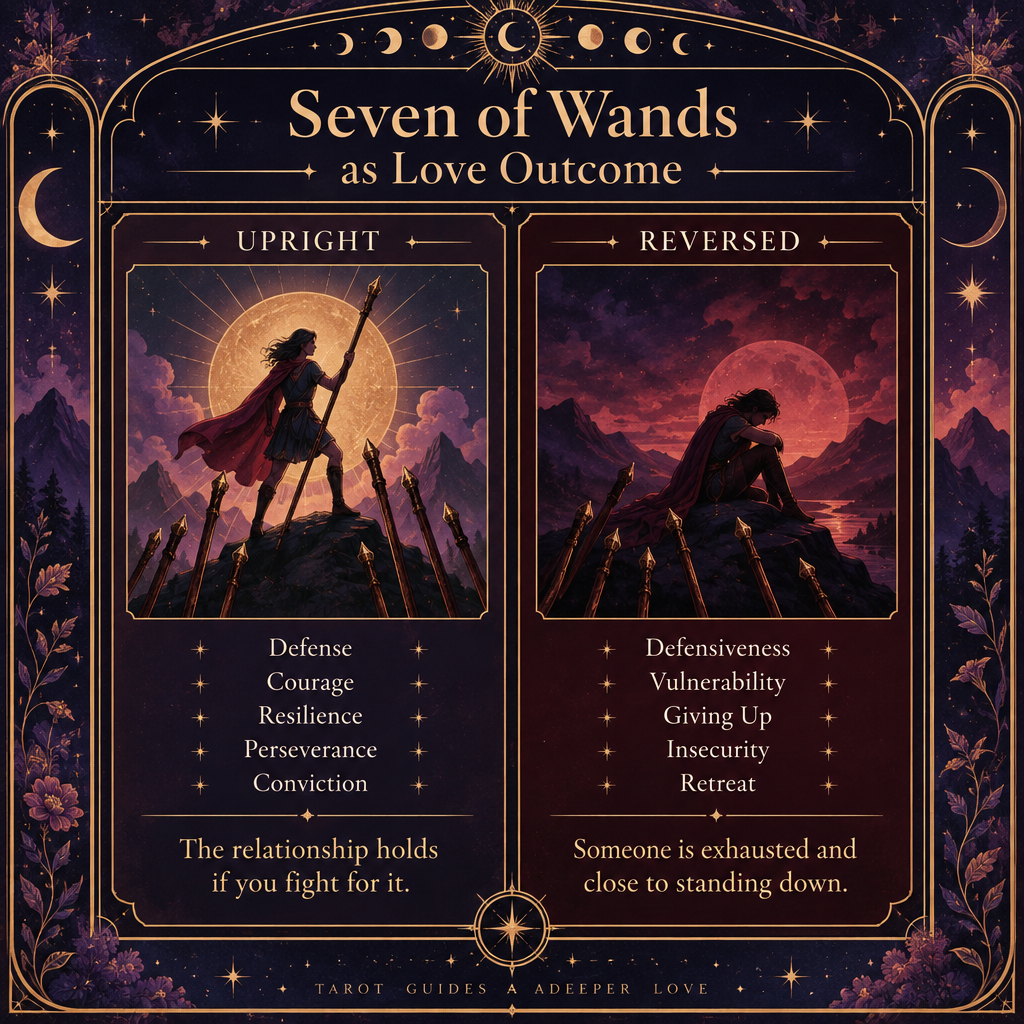
| Upright | Defense, courage, resilience, perseverance, standpoint, conviction | The relationship holds if you fight for it, and the fight is worth it |
| Reversed | Defensiveness, vulnerability, giving up, insecurity, overwhelm, retreat | Someone is exhausted by the battle and is close to standing down |
The upright card answers the question “will this last?” with “yes, if you defend it.” The reversal asks a harder question: are you still defending something worth protecting, or just defending out of habit?
The Imagery, Symbol by Symbol
In the Rider-Waite-Smith deck, a man stands on a green rise with one wand gripped in both hands. Six more wands rise up at him from below, held by attackers you never see. Every element of that picture carries a love interpretation.
The figure on the hill
He occupies the high ground. In a love outcome this is the advantaged position: you (or the relationship itself) already have something worth attacking. People do not challenge couples who are falling apart on their own. The challenge exists because the bond is real enough to threaten someone’s plans, whether that someone is a disapproving parent, a jealous friend, or a former partner who assumed you would come back.
The six wands from below
Six against one is lopsided, and that is the point. The pressures on the relationship are many, but they are uncoordinated and they come from beneath. Translate that literally: the opposition does not have the standing you have. A mother-in-law’s opinion, gossip, a rival’s attention, the strain of a long-distance schedule. None of these can win unless the person on the hill stops holding the wand.
The mismatched footwear
Pamela Colman Smith painted the figure wearing a boot on one foot and a shoe on the other. He dressed in a hurry. Nobody gave him time to prepare. In love this describes conflict that arrived before the couple felt ready for it: the pregnancy nobody planned, the job offer in another city, the ex who resurfaced two months into something new. The message is that readiness is not a prerequisite for defending what you have. You use what you have on.
The open sky
Behind the figure there is nothing but pale, clear sky. No storm, no walls, no crowd. Despite the chaos below, the space above him is calm. This is the card’s quiet reassurance: once the current challenge is answered, there is room to grow. The fight is not the whole story.
Fire, Wands and Mars in Leo
The Wands suit belongs to the element of Fire, which governs desire, will, passion and action. Sevens in every suit mark a test, the point where early momentum meets resistance. Put those together and the Seven of Wands in love is desire under pressure.
Astrologically the card corresponds to Mars in Leo, the third decan of Leo (roughly the last ten days of the sign). Mars is the warrior; Leo is pride, loyalty and the heart. Mars in Leo defends what it loves loudly and refuses to be embarrassed about doing so. In a love outcome this produces a very specific flavour of commitment:
- Loyalty that is public, not private. The Mars in Leo partner will introduce you to everyone and argue with anyone who disrespects the relationship.
- Pride that can tip into stubbornness. The same energy that defends you will refuse to admit a mistake in an argument.
- Heat that needs a target. If there is no external opponent, Mars in Leo sometimes manufactures one inside the relationship.
The Golden Dawn titled this card the Lord of Valour. Valour, not victory. The card promises courage in the fight, and the outcome depends on whether that courage is sustained.
Seven of Wands Upright as a Love Outcome
Upright, this card tells you the relationship has a future that must be earned. It is a conditional yes. Someone has to keep standing, and the question for each situation is who, and against what.
In an established relationship
Expect a stretch where the two of you are a team against something outside. Common forms:
- A parent or in-law who makes their disapproval known and keeps making it known.
- A friend group that treats one partner as an outsider.
- A long-distance phase, relocation or demanding job that competes for time.
- A former partner, of either of you, who will not fully exit.
The upright card says you win this if you present a united front. The relationship is not the problem; the siege is. Couples who fail this test usually fail because one partner defends the relationship to outsiders while quietly agreeing with the critics at home. Decide together what the shared position is, then hold it.
Practical step: name the opponent out loud. “Your sister’s comments” or “the three-hour commute” is something you can plan around. Vague tension is not.
If you are single
For an unattached reader the Seven of Wands as the outcome means the love you want will meet resistance, and you will have to insist on it. Three readings are most common:
- Someone is interested in you but has competition, and they will have to step up to win you. The card favours the one who makes the effort.
- You are attracting people who test your boundaries early. The outcome is good if you hold the line on what you will and will not accept.
- Your own standards are being questioned by friends who think you are “too picky.” The card says keep them. Being on the hill alone is better than coming down for someone who does not deserve it.
For singles the advice is identical to the imagery: stay elevated. The right person climbs. You do not descend.
If you are asking about an ex or a reconciliation
This is one of the most searched variants, and the card is clearer than most people expect. Upright, the Seven of Wands as a reconciliation outcome says the ex is willing to fight to get back in. The return is active, not passive. They will not drift back; they will argue their case, push past their own pride and probably push past your friends’ objections too.
The catch is that a reconciliation won under the Seven of Wands stays contested. Whatever broke you up the first time is still standing at the bottom of the hill. If the reunion happens, both of you will need to keep defending it against the same old pressures, and against your own doubts. Ask yourself honestly whether you want a relationship that requires that level of guard. Some people find it romantic. Others find it exhausting within a year.
During a separation
Separated couples who draw this card are not done. One or both of you is still fighting, and the separation itself is the battleground. Someone is refusing to sign, refusing to move out, refusing to let the other person’s family have the last word. The card does not tell you the fight is wise. It tells you it is ongoing.
The honest question the Seven of Wands poses here: is this separation an attack on the relationship worth repelling, or is it the relationship’s natural end, and you are defending a position that no longer exists? Upright leans toward the first. The energy is still there, and the person holding the wand still believes in the hill. If that is you, make the case directly and once, rather than through months of attrition.
Seven of Wands Reversed as a Love Outcome
The reversal keeps the battle but strips away the valour. The figure has either dropped his wand, or he is swinging it at shadows. In love this produces several distinct patterns, and you should identify which one you are looking at.
Battle fatigue
The most frequent reading. One or both partners have been defending the relationship for so long that there is nothing left for the relationship itself. Every conversation is about the in-laws, the ex, the distance, the money, and none of it is about the two of you. The outcome card reversed often predicts that someone will simply stop. Not a dramatic exit, just a quiet refusal to argue anymore.
Jealousy and defensiveness turned inward
When there is no real external threat, Mars in Leo finds one inside. The reversed Seven of Wands can show a partner who treats every colleague, every friend, every notification as an attacker. The relationship becomes a fortress with the enemy imagined. If you are the one being guarded, this card is telling you the suspicion will not ease on its own.
Power imbalance
Reversed, the hill becomes a problem. One partner is permanently elevated: always right, always the one who gets to define what the relationship is defending. The other is permanently below, pushing a wand up and never getting through. A love outcome of this card reversed in a reading about an uneven relationship confirms the imbalance will persist unless the person on the hill chooses to come down.
Lowering your standards
For singles, and for people who have been asked to compromise on something fundamental, the reversal shows surrender of the high ground. You stop insisting on honesty, or exclusivity, or basic respect, because holding out feels lonely. The card’s warning is that the hill is not just a position; it is who you are in relationships. Giving it up to end the siege leaves you with a partner who won by wearing you down.
Reconciliation reversed
If you asked about an ex and received the reversed Seven of Wands, they are too tired to try, or they tried once and were rebuffed and will not try again. Occasionally it shows an ex who wants to return but cannot face the opposition (their family, their new partner, their own embarrassment). Either way, do not expect them to climb the hill. If you want the reunion, you would have to go to them, and the card suggests you would be doing most of the work.
The reframe: which battles are worth fighting
The reversal is not purely negative. Read as advice rather than prediction, it is a prompt to audit the war. List what you have actually been defending the relationship against over the last six months. Some items will be real threats. Others will be fights you keep picking because stopping feels like losing. Drop the second category. Relationships that survive the reversed Seven of Wands do so by shrinking the battlefield, not by fighting harder.
Healthy Defense or Unhealthy Dynamic?
The same card can describe a couple heroically holding out against prejudice or a couple locked in chronic, corrosive conflict. Use these markers to tell which you are reading.
| Healthy Seven of Wands | Unhealthy Seven of Wands |
|---|---|
| The opponent is clearly external (family, distance, rival) | The “opponent” keeps changing or is the partner |
| Both partners agree on what they are defending | One partner defends, the other quietly sides with critics |
| Conflict is episodic, with calm sky between fights | Conflict is constant; there is no calm |
| Defending the relationship costs energy but feels worth it | Defending it costs more than the relationship gives back |
| Upright, often beside Cups cards | Reversed, or upright beside Swords cards |
If three or more markers fall in the right-hand column, the outcome the card describes is a relationship that ends by exhaustion, not by decision.
Seven of Wands Yes or No for Love
Upright: yes, conditionally. The relationship, reunion or connection you asked about is achievable, but only with sustained effort against real opposition. Nothing about it is automatic.
Reversed: leaning no. The effort required is more than at least one person is willing to give, and the likely outcome is retreat or surrender rather than resolution.
Seven of Wands Love Combinations
The outcome card rarely stands alone. These pairings change its meaning most sharply.
Seven of Wands + Two of Cups. The relationship is worth every bit of the fight. Opposition is external and the bond underneath is mutual and genuine. One of the most encouraging combinations in a contested relationship.
Seven of Wands + Three of Swords. The conflict itself is the wound. Defending the relationship has caused the heartbreak, often through harsh words said in the heat of defense. Outcome leans toward ending.
Seven of Wands + The Tower. An external shock forces the battle: a discovered affair, a sudden loss, a job collapse. The couple has no time to prepare (recall the mismatched shoes). Whether they survive depends entirely on whether they face the rubble together.
Seven of Wands + Five of Wands. Petty, scattered conflict rather than one clear threat. Everyone is squabbling and no one is actually defending anything. Reconciliations under this pair tend to be noisy and short.
Seven of Wands + Strength. The defense will be calm, patient and ultimately successful. This pair favours the partner who holds boundaries without aggression. Excellent for in-law conflict.
Seven of Wands + Nine of Wands. Long siege, nearly over. Both partners are battle-scarred but still standing. The relationship survives, though it will need deliberate rest afterwards.
Seven of Wands + Ten of Swords. Stand down. The battle is already lost and continuing to fight only prolongs the pain. Usually confirms a reversed reading even when the Seven itself is upright.
Seven of Wands + The Lovers. A values test. The relationship is being challenged on a fundamental choice (religion, children, location), and the outcome depends on whether both partners choose the same side.
A Three-Card Spread When the Seven of Wands Appears
If the Seven of Wands lands as your outcome and you want more detail, pull three clarifiers:
- What am I actually defending? Reveals whether the thing under attack is the relationship, your pride, or your fear of being alone.
- Who or what is at the bottom of the hill? Names the opposition. Court cards here often identify a specific person.
- What happens if I stand down? Shows the cost of surrender, which is sometimes smaller than the cost of continuing.
Read all three alongside the Seven. If the first card is a Cups card and the third is a Swords card, keep fighting. If the first card is a Swords card and the third is a Cups card, you have your answer.
FAQ
Is the Seven of Wands a good card in love?
Yes, with a condition attached. It confirms the relationship is real enough to provoke opposition and strong enough to survive it, but only if you actively defend it. It is not a card of easy love. Reversed, it tips toward negative because the energy to defend is running out.
Does the Seven of Wands mean someone will fight for me?
Upright, yes. It is one of the clearest cards for “this person will push past obstacles to be with you.” If the question is about a specific person’s feelings, expect loyalty that is vocal and public rather than quiet.
What does the Seven of Wands reversed mean as a love outcome?
Exhaustion, retreat and uneven power. One partner has stopped defending the relationship, or is defending it against imagined threats, or holds all the control. The relationship can continue, but not in its current shape.
What does it mean if I draw the Seven of Wands about my ex?
Upright: your ex is willing to fight to come back, and the reunion will face the same pressures that caused the first split. Reversed: they are too tired or too proud to try, and any reconciliation would require you to do most of the work.
Is the Seven of Wands yes or no in love?
Upright is a conditional yes. Reversed leans no.
Can the Seven of Wands mean a breakup?
On its own, rarely. Combined with the Three of Swords, Ten of Swords or the Tower, or when reversed in a reading about long-running conflict, it describes a relationship ending through exhaustion rather than a clean decision.
What is the astrological meaning of the Seven of Wands in love?
Mars in Leo: passionate, loyal, proud, and quick to defend. In relationships it produces partners who will stand up for you in public but who struggle to back down in private disagreements.