

Pulling the Three of Swords when you ask how someone feels about you is rarely the answer you wanted, but it is one of the most honest cards in the deck. It points to hurt, a painful truth, or a wound that is still shaping how this person relates to you. Here is what it means for their feelings at every stage, from a new situationship to a decades-long marriage, plus what the reversal changes and what to actually do next.
Last reviewed and updated for 2026 by our tarot editorial team.
What the Card Shows, and Why It Matters for Feelings Readings
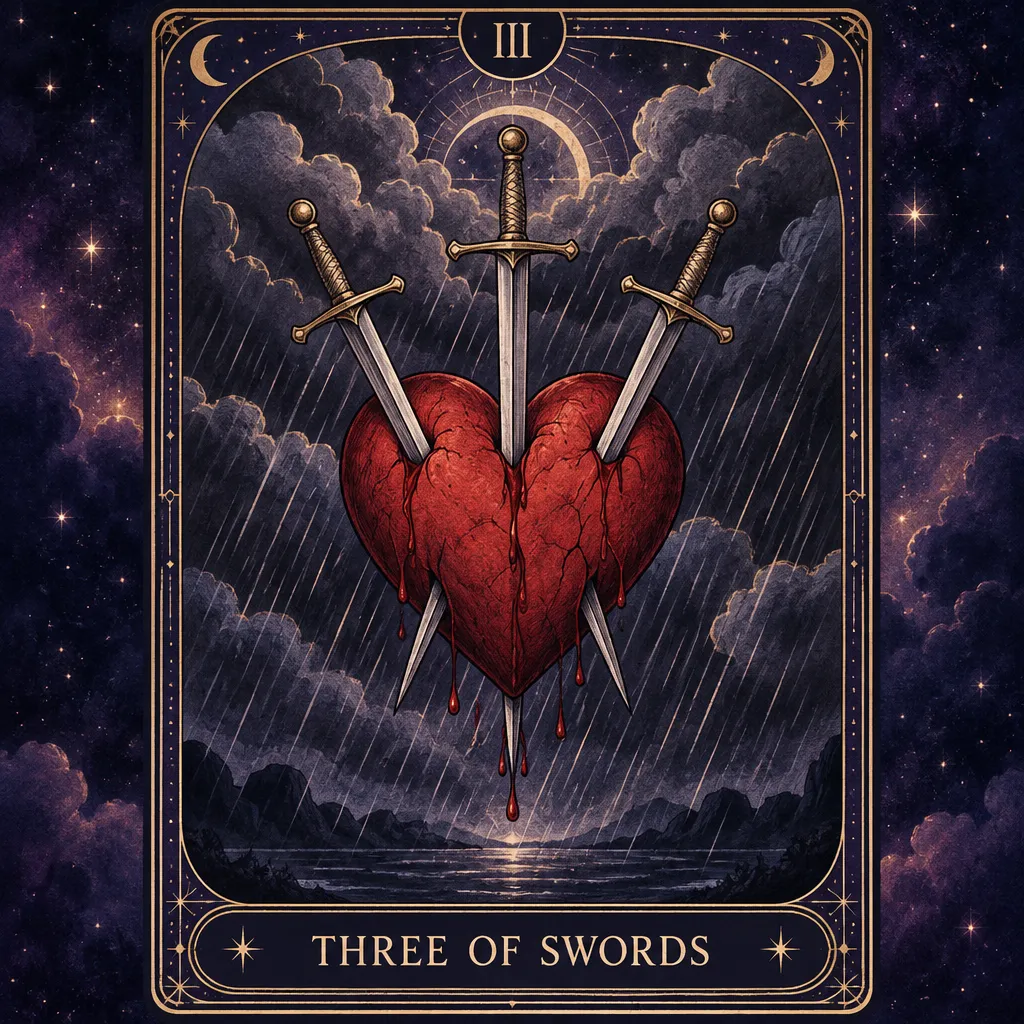
In the Rider-Waite-Smith deck, illustrated by Pamela Colman Smith in 1909, the Three of Swords is one of the few Minor Arcana cards with no human figure. There is a large red heart suspended in the air, three swords driven straight through it, grey storm clouds behind, and rain falling in heavy diagonal lines. That is the whole picture.
The absence of a person is the point. This is not a card about what someone is doing. It is a card about what someone is feeling on the inside, which is exactly why it carries so much weight in a feelings reading. The heart is exposed, not hidden in a chest. The swords, which belong to the suit of thought and speech, show that the damage was done by words, truths, or realisations rather than by physical events. The rain is grief being released. Storm clouds pass; they do not stay.
The Golden Dawn assigned this card to Saturn in Libra and gave it the title “Lord of Sorrow.” Libra is the sign of partnership and balance. Saturn is restriction, delay, lessons, and consequences. Put together you get the emotional signature of the card: a relationship or connection meeting a hard limit, and the sorrow that comes from learning something true about it. Saturn does not punish for the sake of it. It makes you face what you were avoiding. Keep that in mind when you read this card for someone’s feelings, because their pain often sits right next to a lesson they have not finished learning.
Three of Swords as Feelings About You (Upright)
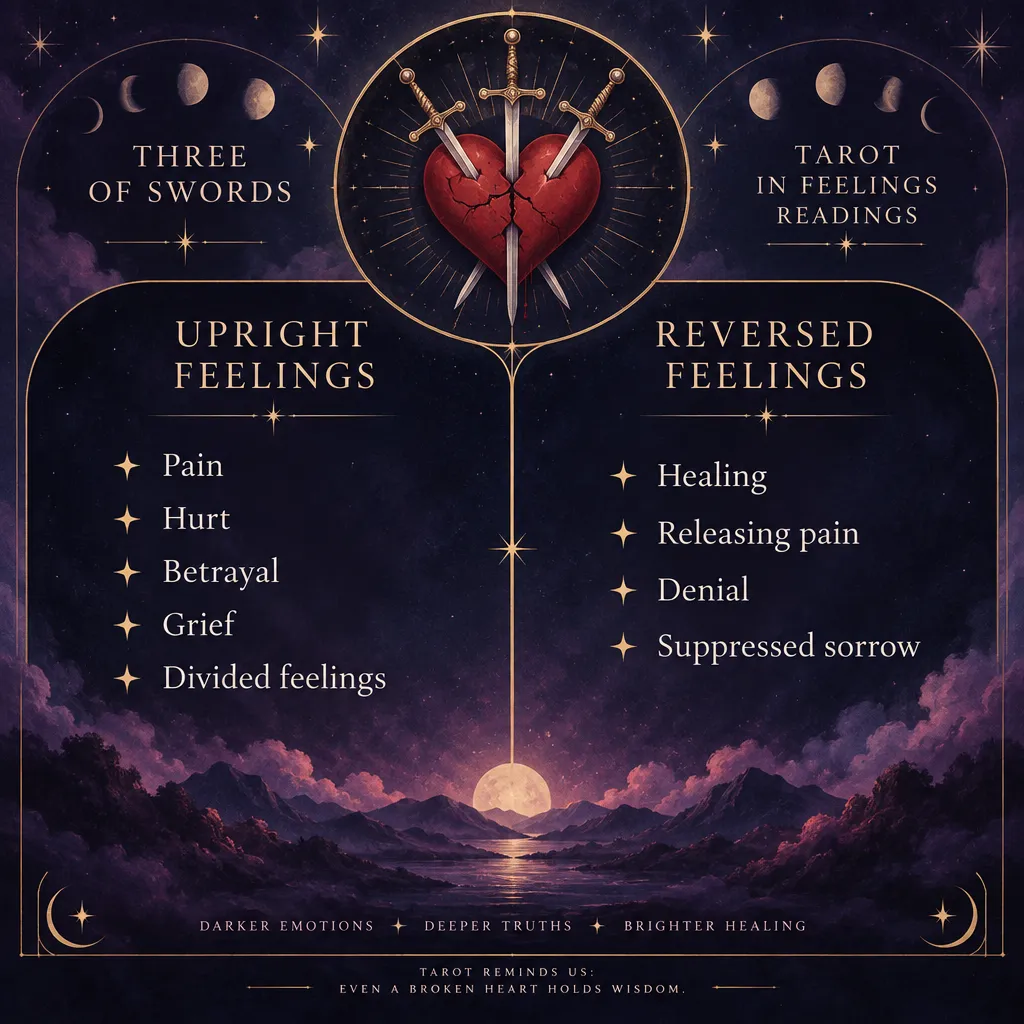
Upright, the Three of Swords says this person associates you with pain. That does not automatically mean they dislike you or want you gone. It means that when they think of you, the dominant emotion is hurt.
In practice this usually falls into one of three shapes:
- You hurt them. Something you said, did, or failed to do landed hard. They may not have told you how deep it went.
- They are hurting over you. They have feelings for you that they believe cannot work out, so thinking about you is bittersweet at best.
- They are carrying older wounds into this. Their pain predates you, but you are now the person it attaches to. They may be bracing for you to hurt them the way someone else did.
Ask yourself which one fits the context. If you recently had a fight, option one is the obvious read. If they have been pulling away from a connection that seemed to be going well, option three is more likely. If you are reading on someone you have never dated, option two deserves serious consideration, because this card often turns up for a person who feels something and has already decided it is hopeless.
Betrayal, painful truths, and broken trust
Heartbreak is the surface meaning. Betrayal is the deeper one. The Three of Swords upright very often describes the moment a person learns something that changes how they see you: a lie uncovered, a promise broken, a message they were not supposed to read, a version of events that does not match yours.
For feelings, this means the person is dealing with a split between who they thought you were and what they now believe. That is more painful than a simple argument because it attacks their judgement as well as their heart. They may feel foolish for trusting you, angry at themselves, or quietly convinced that they can never rely on you again even if they stay.
If you are the one who feels betrayed and you pull this card for the other person, read it as confirmation that they know what they did and that it is weighing on them. Guilt is a real reading for this card. People do not always show it.
Love triangles and third-party interference
The three swords are a literal count: three people. This card is one of the clearest signals in the deck that someone else is affecting the connection. That might be:
- An ex who is still emotionally present for one of you
- A new person your partner is talking to, even if “nothing has happened”
- A family member or friend who disapproves and keeps pushing a wedge in
- In online dating and situationships, a roster of other matches that keeps the person from committing to any one
For feelings, the third-party read means this person is conflicted. They are not fully present with you because part of their attention and emotion is pointed elsewhere. They may feel guilty about it, or they may feel genuinely torn. Either way, their feelings for you are real but divided, and divided feelings create exactly the kind of sorrow the card depicts.
Feelings by relationship stage
New connection or situationship. They feel vulnerable and slightly afraid. The upright card here shows someone who has been burned before and is reading your every move for signs it will happen again. They may ghost or go cold not because they do not care, but because caring feels dangerous. The original advice stands: take it slowly, be consistent, and do not make promises you cannot keep.
Long-distance. The card points to loneliness and a specific hurt, often a missed call, a cancelled visit, or a conversation that went wrong over text where tone could not be read. They feel the distance as a wound rather than as a logistical problem.
Established relationship. They feel let down. Something has broken the sense of safety. This deserves its own section below because the stakes are higher.
Three of Swords as Feelings About You (Reversed)
The reversal has two opposite readings, and treating it as purely positive is a mistake. You need to decide which applies, and the surrounding cards will tell you.
Reading one: healing, release, and forgiveness
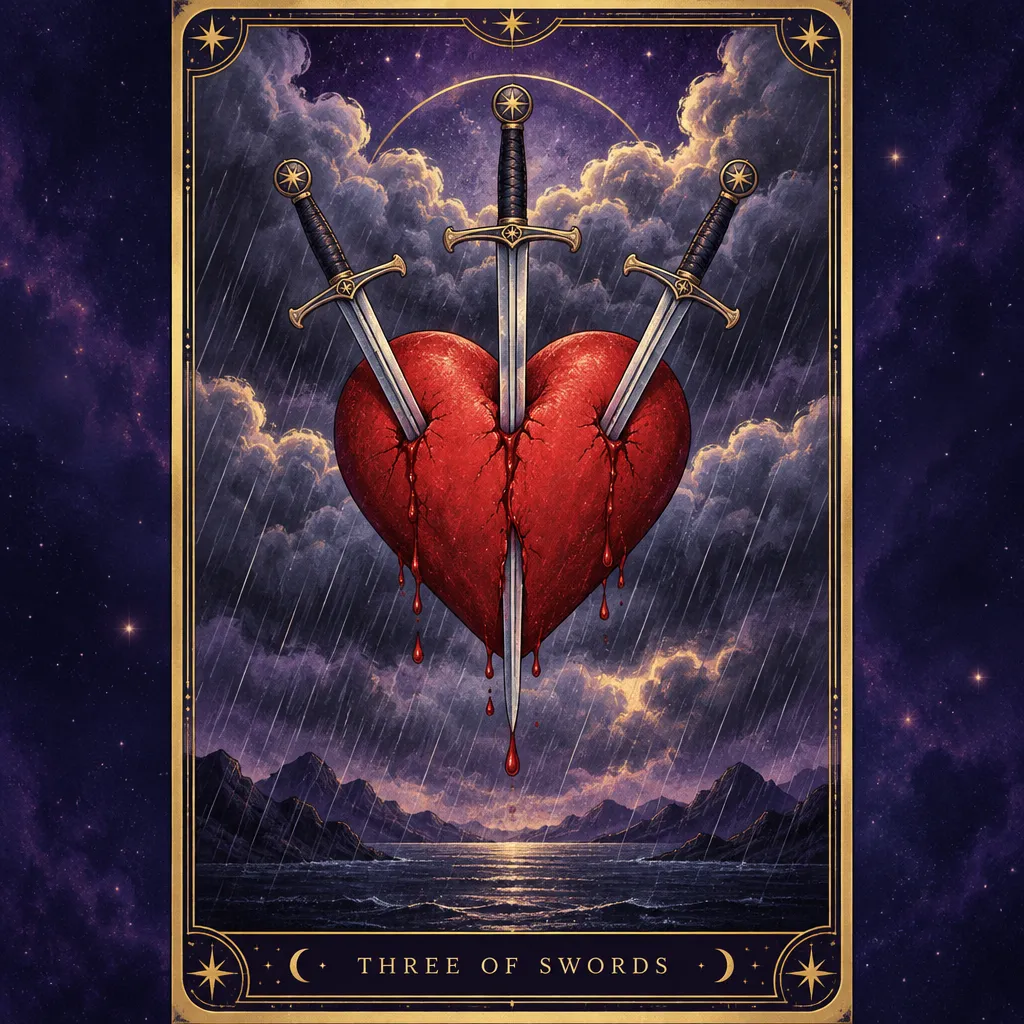
Reversed, the swords are falling out of the heart. The rain has stopped. This person is on the other side of the worst of the pain. If they were hurt by you, they have started to forgive, or at least to stop replaying it every day. If they were hurt by someone before you, they are becoming able to trust again, and you may be the person benefiting from that.
The feeling here is relief with a little caution underneath. They are not fully open yet, but they are no longer closed. Expect warmer contact, more willingness to talk, and a softening of old grievances. If you have been waiting for an apology or a thaw, this reversal says it is coming.
Reading two: repressed grief and festering resentment
The other reversal is a heart that has turned upside down to hide its wound. The person is still in pain and refusing to look at it. They have told you, and themselves, that they are fine. They are not fine.
This is the more common reading when the relationship has been outwardly calm but emotionally flat. Resentment that is never spoken does not disappear; it compounds. The feeling here is suppressed anger, quiet disappointment, or grief that has gone numb. They may feel they cannot bring the subject up because it would blow everything apart, so they say nothing and pull away by degrees.
For someone you are no longer with, this reversal often means they never properly processed the ending. They may act indifferent while still carrying the hurt, and that unprocessed pain can keep them from moving on or from coming back.
How to tell which reversal you are looking at
Look at the cards around it. The Star, the Six of Cups, Temperance, or the Ace of Cups nearby favours the healing reading. The Five of Cups, the Four of Cups, the Eight of Swords, or the Nine of Swords nearby favours repression. Also look at the person’s behaviour. Someone healing tends to reach out more, not less. Someone repressing tends to become polite and distant at the same time.
Three of Swords in Long-Term Relationships
In an established partnership this card describes a specific breach rather than a general drift. Something happened. It could be an emotional affair, a financial secret, a comment about the relationship made to a friend that got back to you, or a long-promised change that never came. The partner who pulls this card as the other person’s feelings should assume that person feels genuinely wounded, even if the incident seems small from the outside.
Long-term couples often fall into the second reversed reading. Years of small hurts get filed away unspoken because the relationship works well enough day to day. The Three of Swords reversed here is a warning that the filing cabinet is full. Painful conversations are better than the slow erosion of a partner who has stopped expecting to be heard.
There is also a plainer read in long relationships: shared grief. A bereavement, a miscarriage, a job loss, or a health crisis can bring up this card for how a partner feels, and it has nothing to do with the relationship itself. They are hurting, and they need you to be present rather than to fix anything.
Three of Swords for an Ex and Reconciliation
How your ex feels about you after the breakup
Upright, your ex still feels the pain of the ending. This is true whether they left or you did. People who initiate breakups pull this card constantly; ending something is not the same as being over it. If there was betrayal involved, they may also feel guilt or self-recrimination that they will never admit to you.
Reversed, either they have mostly healed and are moving forward (which can sting if you were hoping they still hurt), or they have buried it so deep they appear cold. The buried version is more likely if the breakup was abrupt and nothing was ever resolved between you.
Will we get back together?
The Three of Swords is not a reconciliation card. Upright, it says the wound that ended things is still open, and reconciling now would mean reopening it. Any reunion on this energy tends to repeat the original hurt.
Reversed in the healing sense, reconciliation becomes possible but not guaranteed. The forgiveness needed for it is forming. Reversed in the repressed sense, a reunion is unwise, because the issues that caused the split have not been dealt with; they have only been hidden.
The honest advice for anyone hoping to reconcile on this card: whatever caused the heartbreak must be named out loud and fully owned by whoever caused it. Skipping that step is how couples end up pulling this card again a year later.
Three of Swords as Love Advice
Upright advice
Face the painful truth now, not later. If you owe an apology, make it specific and without excuses. If you are the one hurt, say so plainly rather than hinting and hoping they notice. The card is telling you that avoidance is the actual problem.
Give grief its time. If a relationship has just ended, do not rush into a rebound or a reconciliation attempt within the first few weeks. The storm on the card is still active; wait for it to pass before making permanent decisions.
If a third party is involved, stop pretending they are not. Ask the direct question. The answer will hurt less than months of suspicion.
Reversed advice
If the healing reading applies, your job is to let it happen. Do not keep bringing up the old hurt to check whether they are really over it. Accept the apology or offer yours, then move forward.
If the repressed reading applies, your advice is almost the opposite of the upright card’s: bring the hurt into the open yourself, gently, because the other person will not. Say what you have noticed. Make it safe for them to admit they are still carrying something.
Self-forgiveness belongs here too. The reversed card often turns up for people who have been punishing themselves for how a relationship ended. Saturn’s lesson is learned when you stop repeating the mistake, not when you have suffered enough.
Three of Swords as Love Outcome
As an outcome card, upright, expect a painful development before any resolution: a difficult conversation, a separation period, or a truth coming to light. It does not always mean the relationship ends. It means the relationship cannot continue as it currently is. For a new connection, the outcome is usually that it does not progress, or that it ends after causing some hurt.
Reversed as an outcome, the healing reading points to recovery after a hard stretch: the fight gets resolved, the trust gets rebuilt slowly, or the breakup turns out to be the right thing and both people land somewhere better. The repressed reading as an outcome means things look settled on the surface while the real problem waits. That is an unstable peace, and you should treat it as a prompt to act rather than a happy ending.
Attachment Styles and the Three of Swords
This card has a strong connection to anxious and fearful-avoidant attachment. Someone with an anxious style feels the Three of Swords when a text goes unanswered for a few hours; their nervous system treats small gaps as abandonment. Someone with a fearful-avoidant style feels it as the dread of getting close, because closeness has historically meant pain.
If you pull this card for a person who repeatedly pulls away right after moments of intimacy, you are likely looking at the fearful-avoidant pattern. Their feelings for you are real, which is exactly why they run. Understanding this does not oblige you to tolerate it indefinitely, but it does mean the withdrawal is about their wound rather than about your worth.
For your own reading, if this card keeps appearing when you ask about different people, the pattern is probably in you rather than in them.
Three of Swords as a Person
As a description of someone, the Three of Swords upright is a person currently grieving or recently betrayed. They are raw, guarded, prone to tears or to sharp words, and not in a position to give a relationship their full self. They may be deeply lovable and still not available.
Reversed, this person is either visibly recovering, more open than they were a year ago and willing to try again, or they are the quietly bitter type who insists everything is fine and keeps score in private. Date the first version slowly. Be careful with the second.
Three of Swords: Yes or No?
For love questions, the Three of Swords upright is a no. Will they come back, do they love me, is this going to work: the card answers no, or not without pain first.
Reversed, it leans toward a soft yes only in the healing reading, and only if the question concerns recovery rather than romance. “Will I get over this?” Yes. “Will this relationship work?” Still uncertain, and usually leaning no if the surrounding cards are heavy.
Key Card Combinations in Love Readings
| Pairing | What it means for feelings |
|---|---|
| Three of Swords + Ten of Swords | A definitive ending. The person feels the relationship is over and cannot be revived. Deep hurt with no appetite to continue. |
| Three of Swords + The Star | Pain now, healing ahead. They are hurting but hopeful, and forgiveness is realistic. |
| Three of Swords + Two of Cups | Conflict in a promising connection. Genuine mutual feeling complicated by a hurt that needs addressing before it can grow. |
| Three of Swords + The Lovers | A painful choice, often involving a third party. They feel torn between two people or between the relationship and something else. |
| Three of Swords + King of Swords | Cold, cutting words from a detached man or a decisive, rational ending. They may have been hurt by harsh honesty, or they have decided to end things on principle. |
| Three of Swords + Death | Transformation through loss. The old form of the relationship is finished; what comes next, if anything, will be different. |
| Three of Swords + Seven of Swords | Deceit uncovered. Betrayal is confirmed rather than suspected. |
Practical Next Steps When This Card Appears
Write down exactly what you think the hurt is. Not the argument, the hurt underneath it. If you cannot name it, you cannot address it.
Have the conversation within days, not months. The upright card gets worse with time; the reversed repressed card is what delay turns into.
If you are grieving a breakup, set a rough boundary for yourself: a few weeks of no contact and no reading on them before you reassess. Reading tarot on an ex daily keeps the swords in the heart.
If a third party is confirmed, decide what you can and cannot live with before you talk, so that you do not negotiate your boundaries away in the moment.
Pull a follow-up card asking “what helps this heal?” rather than “do they love me?” again. The Three of Swords has already answered the second question. The first one is where the useful information is.
FAQ
What does the Three of Swords mean for how someone feels about you?
Upright, they associate you with pain. Either you hurt them, they are hurting over feelings for you that they believe cannot work, or they are projecting old wounds onto you. Betrayal, a painful truth, or a third person is frequently involved. Reversed, they are either healing and softening toward you, or suppressing hurt they refuse to discuss. Check the surrounding cards and their recent behaviour to tell which.
Is the Three of Swords a yes or no card in love?
Upright, it is a no for romantic questions. Reversed, it is a qualified yes only for questions about recovery and healing, and still a lean toward no for whether a specific relationship will work out.
What does the Three of Swords reversed mean in love?
It has two readings. The first is healing: the pain is leaving, forgiveness is possible, and the person is becoming open again. The second is repression: the pain is still there but hidden, turning into resentment or numbness. The second is more common in long relationships where nothing was ever openly resolved.
Does the Three of Swords mean cheating?
Not always, but it is one of the stronger indicators of third-party interference in the deck, especially alongside The Lovers, the Seven of Swords, or the Three of Cups reversed. On its own it means a hurtful truth of some kind; the nature of that truth depends on context.
Can a relationship survive the Three of Swords?
Yes, if the hurt is named and owned. The card does not say the relationship is over. It says it cannot continue in its current form without the pain being addressed. Couples who have the hard conversation often come out stronger. Couples who skip it tend to pull this card again.
Add Yes No Tarot as a preferred source on Google, and the sites you pick are more likely to appear in your Top Stories.