Devil As How Someone Sees You (Upright & Reversed) Tarot Card Meaning
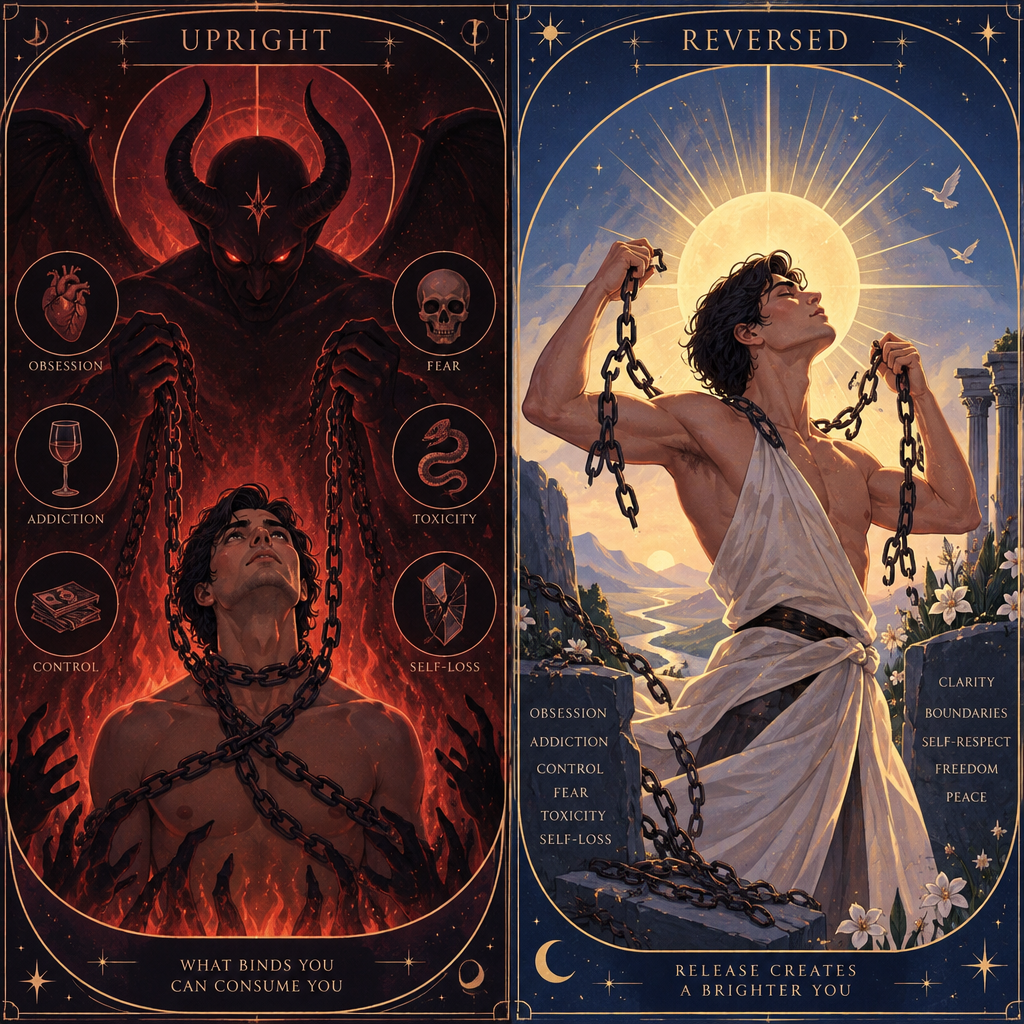
The Devil in the “how someone sees you” position means you occupy a lot of space in that person’s head, and not the comfortable kind. Upright, they see you as a temptation, a habit, or a mirror for parts of themselves they would rather not own. Reversed, they see you as someone who has slipped the chain, or someone they are finally ready to let go of. This guide breaks down both, across love, friendship and work, with card combinations and a plan for what to do next.
The Devil Card: Key Symbols and What They Mean
Every interpretation in this position comes back to the picture on the card, so it is worth knowing what you are looking at. The Rider-Waite-Smith Devil is card XV of the Major Arcana, and it deliberately parodies card VI, The Lovers. Same layout: a large central figure presiding over a naked man and woman. Different message.
Baphomet. The horned, bat-winged, goat-legged figure squatting on a black pedestal. It borrows the raised right hand of the Hierophant and the Magician, but the blessing has turned into a hollow gesture. In this spread position, Baphomet is the role the other person has cast you in: the one who holds the power, the one who sits above the situation.
The inverted pentagram. Drawn between the horns, point down. An upright pentagram places spirit above the four elements; flipped, matter rules spirit. The person sees you through a material or bodily lens first: your looks, your money, your status, what you can do for them, what you make them feel physically.
The torch. Held downward in the left hand, setting fire to the man’s tail. It is not illumination. It is heat that scorches rather than warms, which is why “how someone sees you” readings with this card so often describe attraction that feels more like burning than glowing.
The two chained figures. Naked, horned, growing tails (grapes for her, flame for him). They were the innocent couple from The Lovers, and indulgence has changed their shape. When someone sees you as the Devil, they usually see themselves as one of these figures, and you as the reason they are still standing there.
The loose chains. The single most important detail. The chains around their necks are wide enough to lift off. Nobody is actually trapped. Whatever hold you have over this person, or they believe you have, is one they could walk out of tomorrow. That fact drives the entire reversed meaning.
Keywords at a glance
| Upright | Reversed |
|---|---|
| Addiction, obsession, lust | Liberation, release, detachment |
| Codependency, control | Reclaimed power, boundaries |
| Shadow self, projection | Self-awareness, honesty |
| Materialism, status, appearance | Values over surface, sobriety |
| Guilt, secrecy, shame | Exposure, breaking patterns |
Why the Devil Reads This Way: Capricorn, Earth and Card XV
The Devil is assigned to Capricorn in the Golden Dawn system, which is why the figure has goat features in the first place. Capricorn is cardinal Earth, ruled by Saturn: the sign of ambition, hierarchy, discipline and the long climb for tangible reward. Those qualities are not villainous, but in Devil form they harden into status-seeking, control and an inability to let go of what has been acquired.
Earth is the key to reading this position accurately. A Water card in the “how someone sees you” slot would describe an emotional impression. Earth describes something concrete and embodied. The person sees you in terms of the physical and the practical: chemistry, habit, routine, money, security, sex. When the Devil turns up, their view of you is rooted in what you provide or trigger in the material world, not in a romantic story they tell about your soul.
The card’s number matters too. XV sits between Temperance (XIV, balance) and The Tower (XVI, collapse). It is the moment where balance has been abandoned but consequences have not yet arrived. Someone who sees you as the Devil is in that gap: fully aware that something about their attachment to you is off, but not yet forced to act on it.
“How Someone Sees You” Versus “How Someone Feels About You”
These positions get used interchangeably, and with most cards the difference is small. With the Devil it is not. Readers on tarot forums argue about this constantly, and the argument is worth having, because the two readings can point in opposite directions.
Feelings are what happens inside them. Devil as feelings is fairly simple: they want you, they are hooked, they cannot stop thinking about you, and some of that wanting is tinged with shame.
How they see you is the role they have assigned you in their mental picture. That is a judgement, not a sensation. Two people can have identical Devil feelings (intense desire) and see you completely differently. One casts you as the irresistible temptation they willingly indulge. The other casts you as the manipulator who “made” them feel this way. The first wants more of you. The second is building a case against you.
So when the Devil lands in the “sees you” slot, ask a follow-up question of the spread: do they see me as the chained figure or as Baphomet? Surrounding cards usually answer it. Cups and The Lovers nearby suggest they see you as a shared indulgence. Swords, The Moon or the Seven of Swords suggest they see you as the one holding the chain.
The Shadow Self: Why They See Their Own Demons in You
Carl Jung described the shadow as everything about ourselves we refuse to acknowledge, and he observed that we tend to meet it in other people first. We notice, resent or are fascinated by qualities in others that we have disowned in ourselves. Tarot readers have been mapping the Devil onto this idea for decades, and this spread position is where it is most useful.
When someone sees you as the Devil, a large part of what they are seeing is themselves. Their greed, their lust, their need for control, their fear of being alone. You have become the screen those things get projected onto. This explains the strange contradiction people report with this card: the other person is drawn to you and blames you in the same breath. They are not really describing you. They are describing the part of themselves that your presence activates.
This does not mean the perception is baseless. Projection needs a hook, and you may genuinely be providing one through your behaviour. But it does mean you should hold their view of you loosely. It tells you more about their inner state than about your character.
Devil Upright as How Someone Sees You
The upright card describes a perception built on pull, appetite and a sense of being stuck. How that plays out depends heavily on the relationship.
Singles and new connections
They see you as dangerous in the exciting sense. You are the person they text at 1 a.m. and regret texting at 9 a.m. Attraction is physical first and hard to justify rationally, which is exactly why they keep coming back. There is often a secrecy element: they may not have told friends about you, or they frame you as a guilty pleasure rather than a prospect. If you are looking for something serious, this card is a warning that they have not put you in that category yet. They have put you in the “want” category, which is different.
Existing relationships
In a committed partnership, the Devil in this position is heavier. Your partner sees you as a habit they cannot break, or as someone who holds disproportionate power over them: financially, sexually or emotionally. Common real-world signals include them making jokes about being “whipped”, withdrawing from friends, or accusing you of being controlling while never actually asking for change. The loose chains apply here more than anywhere. They feel trapped, and they have not noticed the door is open. Neither of you may have.
An ex
Your ex sees you as the thing they are trying to stay sober from. Their memory of you is dominated by what they miss physically or what they are ashamed of having tolerated. They may check your profiles, replay old arguments, or describe you to friends as “toxic” while still keeping your number. Reconciliation on Devil terms tends to be a relapse rather than a fresh start, because the perception has not changed, only the proximity.
Friends
The Devil rarely means lust in a platonic context. It means enabling or dependence. Your friend sees you as the one who talks them into the second bottle, the fourth round, the impulse purchase, the gossip. Or they see you as the person they lean on so heavily that they have stopped building other friendships. In a healthier friendship, the card can point to a bond built entirely on shared vices with nothing underneath it. If they have started pulling back, this is likely why.
Colleagues, bosses and clients
At work, the Devil upright is about power and ambition. A boss who sees you this way regards you as a valuable asset they would rather not lose, and may use money, promotions or flattery to keep you tethered. A colleague may see you as ruthlessly ambitious, willing to cut corners, or as someone they are uncomfortably drawn to in a way that complicates the professional relationship. A client sees you as indispensable in a way that makes them resentful. In every version, they perceive you as having leverage.
Healthy Versus Unhealthy Attraction: Where the Devil Sits
Not every Devil is a disaster. Intense attraction is a real thing that real relationships are built on, and the card does show up for couples who are simply very into each other. The question is where on the spectrum the perception falls.
| Healthy end | Devil territory | Unhealthy end |
|---|---|---|
| “I find them magnetic” | “I can’t stop thinking about them” | “I can’t function without them” |
| Desire plus respect | Desire plus guilt | Desire plus resentment |
| Wants more of you | Wants you and hides it | Wants you and blames you |
| Attraction adds to their life | Attraction crowds other things out | Attraction has replaced their life |
The card itself sits squarely in the middle column. Which direction it is heading depends on the surrounding cards and on the actual behaviour you are observing. Secrecy, mood swings around contact, and a growing gap between how they act with you and how they describe you to others all push toward the right-hand column.
Devil Reversed as How Someone Sees You
Reversed, the Devil is about the chain coming off. Someone has noticed the loop is loose, and the card describes how that changes their view of you. There are three consistent readings, and they depend on who did the noticing.
They see you as someone who has broken free
You have changed. You quit something, left something, set a boundary or stopped playing an old role, and they have clocked it. They see you as lighter, more self-possessed, harder to manipulate. For someone who benefited from the old dynamic, this is unsettling. For someone who genuinely cares about you, it is inspiring. Either way, they see you as a person who is no longer available for the old game.
They see you as the catalyst for their own awakening
Sometimes the reversal describes their liberation, and you are the reason for it. Being with you, or losing you, forced them to confront a pattern. They may now see you as the person who showed them what they were doing to themselves. This can be affectionate (gratitude) or uncomfortable (you are the reminder of a version of themselves they want to forget). Exes frequently land here.
They see you as emotionally checked out
The less flattering reading. Detachment can look like freedom from the inside and like coldness from the outside. If you have pulled away, gone quiet or stopped investing, the reversed Devil says they have noticed and read it as you no longer caring. They see you as distant, hard to reach and possibly indifferent. This is not a red flag about you; it is a mismatch between your process and their perception, and it is fixable with a conversation.
The self-perception angle
Occasionally the “someone” in this position turns out to be you. The reversed Devil as how you see yourself describes the moment you stop identifying as the addict, the pushover, the one who always goes back. If the reading feels like it is talking about your own reflection rather than another person’s, take it that way. It usually means the work is further along than you have given yourself credit for.
Devil as How Someone Sees You: Summary Table
| Context | Upright | Reversed |
|---|---|---|
| Single / new connection | A guilty pleasure, a physical pull they haven’t rationalised | Someone self-possessed who won’t play games, or someone who seems distant |
| New relationship | Intoxicating, slightly risky, not yet “serious” | A person who has clear boundaries and expects the same |
| Long-term partner | A habit or power they feel bound to | A partner who has changed, breaking an old pattern |
| Ex | The thing they are trying to stay away from | The person who woke them up, or a chapter they have closed |
| Friend | The enabler, or the one they depend on too much | Someone who has grown and left the old dynamic behind |
| Colleague / boss | An asset with leverage, ambitious, hard to lose | Someone who has stopped playing office politics or is quietly leaving |
Card Combinations in This Position
Pulling a second card to clarify how someone sees you sharpens the Devil considerably. These pairings come up often.
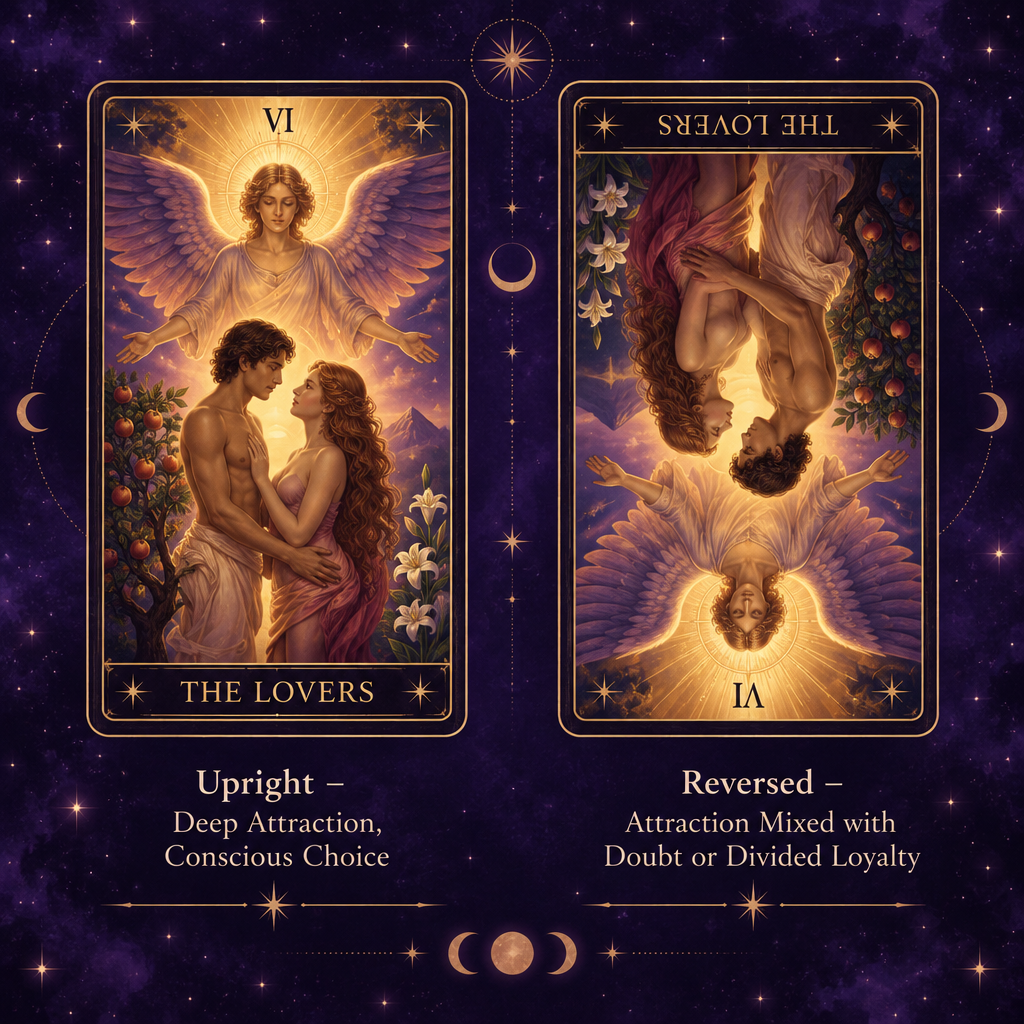
Devil + The Lovers. The two cards are visual twins, so this pairing is loud. They see you as their other half, but the bond is fused rather than chosen. Think “can’t live without you” in the literal sense. Intense, sexual, potentially codependent. If both are upright, the attachment is mutual and neither of you is looking for the exit.
Devil + The Tower. They see you as the person who is about to blow up their life, or already has. The attachment is built on obsession, and card XVI following card XV is the natural consequence: the structure cannot hold. Often appears when an affair is about to be exposed or a controlling relationship is close to rupture.
Devil + Three of Swords. They see you as a source of pain they cannot leave. The knowing is already there; the leaving is not. This is the combination behind the on-and-off relationship that hurts everyone involved and continues anyway.
Devil + The Star. A softer pairing. They see you as a temptation, but also as hope: the person who might actually be good for them if the dynamic changed. Frequently shows up early in a relationship with strong chemistry and unresolved baggage.
Devil + Eight of Swords. They see you as their captor, whether or not that is fair. The Eight of Swords figure is bound and blindfolded but, like the Devil’s couple, could walk away. Expect to be blamed for a situation they are choosing to remain in.
Devil reversed + Six of Swords. They see you as someone who has left, or who has helped them leave. Clean transition energy. Usually good news for both parties even when it stings.
What to Do When You Draw the Devil in This Position
The card describes a perception, not a verdict. Here is how to use it.
-
Separate their view from your reality. Write down the traits the card suggests they see in you, then note which ones you actually recognise in your behaviour and which belong to their projection. Most people find the split is roughly half and half. Own your half.
-
Check for the hook. Ask what you might be doing that keeps the chain loose but still on. Late-night availability, mixed signals, financial support you resent, sexual intimacy without agreed terms. Any of these gives the Devil something to hold.
-
Name the dynamic out loud. If this is a person you want to keep, have a direct conversation about how each of you experiences the relationship. Use plain language: “I feel like you see me as a bad habit rather than a partner. Is that fair?” The Devil thrives on things left unsaid.
-
Decide whether the chemistry is worth the cost. Intensity is not a reason to stay, and it is not a reason to leave. Look at the healthy-versus-unhealthy table above and be honest about which column your situation is actually in.
-
If reversed, protect the progress. Someone who sees you as newly free will sometimes test whether the old you is still available. Expect the test. Hold the line.
-
Re-read in a month. Perceptions built on the Devil shift quickly once behaviour changes. Pull the same position again after you have adjusted something and compare.
FAQ
Is the Devil a positive card when it shows how someone sees you?
Rarely in the straightforward sense, but it is not a rejection. The Devil means you matter to this person intensely. The problem is the quality of that intensity: appetite and attachment rather than respect and choice. In a new, mutually consensual connection with good communication, it can simply describe strong chemistry. In a long-term or already troubled situation, treat it as a warning about dependence and power.
What is the difference between Devil as how someone sees you and how they feel about you?
Feelings describe what is happening inside them: wanting, obsession, guilt. “How they see you” describes the role they have assigned you: the temptation, the addiction, the one in control. Two people can feel the same pull toward you and see you in opposite ways, one as a pleasure and one as a manipulator. Read the surrounding cards to work out which figure on the card they have cast you as.
What does the Devil reversed mean in a how-someone-sees-you reading?
Liberation. Either they see you as someone who has broken free of an old pattern and cannot be pulled back into it, or they see you as the catalyst for their own awakening. The one negative reading is that they interpret your new detachment as emotional coldness. In every version, the chain has come off and they have noticed.
Can the Devil mean strong attraction?
Yes, and it often does. Sexual and physical magnetism is one of the card’s core meanings, tied to its Earth element and the two naked figures. The question is whether the attraction is accompanied by respect and freedom or by guilt and dependence. Pair it with The Lovers or the Two of Cups and it leans toward mutual desire. Pair it with Swords or The Moon and it leans toward obsession.
Is the Devil a yes or no card?
As a general yes-or-no, it is a no, or at best a “yes, but you won’t like the terms”. In the “how someone sees you” position the yes-or-no framing is less useful, because the card is describing a perception rather than an outcome. If your question is “do they want me”, the answer is yes. If it is “do they see me as a healthy partner”, the upright card says not yet.
Does the Devil always mean the other person is toxic?
No. The card describes a dynamic, and dynamics involve two people. Frequently the person who sees you as the Devil is projecting their own shadow onto you, which says more about them than you. Just as frequently, you are contributing something that keeps the pattern alive. Use the card as a prompt to look at both sides rather than as a label for either of you.