5 Tarot Spreads for Love Questions (Yes/No & Beyond)
The best tarot spreads for love questions are small ones: a single card for a yes or no, three cards for a feelings check, and five cards at most for a full relationship picture. Bigger layouts tend to blur the answer rather than sharpen it. Below are five layouts you can use tonight, each with position meanings, sample questions, and a worked example so you know what a reading looks like in practice.
Why Small Spreads Work Better for Love
Love questions carry emotional charge. When you lay out ten cards about someone you can’t stop thinking about, every card starts to look like proof of what you already hoped or feared. That’s confirmation bias doing the reading for you.
A one, three, or five card spread forces discipline. Each position asks one narrow question, so you read the card against that question rather than against your mood. It also keeps the session short, which matters, because the fourth re-draw of the night is never more accurate than the first.
The standard 78-card deck gives you plenty to work with in a small layout. The 22 Major Arcana flag the big, fated themes. The 56 Minor Arcana (four suits of 14) handle the day-to-day texture, and the suit of Cups, the water suit, speaks directly to feelings. If a love spread comes up heavy on Cups, you’re reading an emotional story. Heavy on Swords, and the story is about thoughts, words, and conflict.
Formulating Love Questions: A Quick Guide
How you ask matters more than which spread you pick. Weak questions produce vague answers, and vague answers get interpreted however you want them to be. Here’s how to tighten them before you shuffle.
| Weak question | Why it fails | Stronger version |
|---|---|---|
| “Does he love me?” | Asks the cards to read a mind you can’t verify | “What does his behaviour toward me currently reflect?” |
| “Will we get married?” | Demands a fixed future from a tool that reads tendencies | “What is this relationship moving toward if nothing changes?” |
| “Why hasn’t she texted?” | Invites you to invent a story | “What do I need to know about the silence right now?” |
| “Is he the one?” | Hands all your agency to the deck | “What does this connection offer me, and what does it cost?” |
| “Should I break up?” | Yes/no on a decision only you can make | “What am I not seeing about staying? About leaving?” |
Three rules sit underneath that table.
Keep the question about you or about the connection, not about controlling the other person. “How can I show up better for my partner this week” will give you something usable. “How do I make him commit” will give you a card you can’t act on.
Ask one thing at a time. “Are they interested, and if so when will they ask me out, and will it work” is three questions. Pull for each separately or you’ll end up assigning the cards to whichever sub-question you like most.
Give the question a time frame when you can. “Over the next month” or “in the current situation” grounds the reading. Open-ended forever questions produce open-ended forever answers.
Spread 1: The One-Card Yes/No Pull
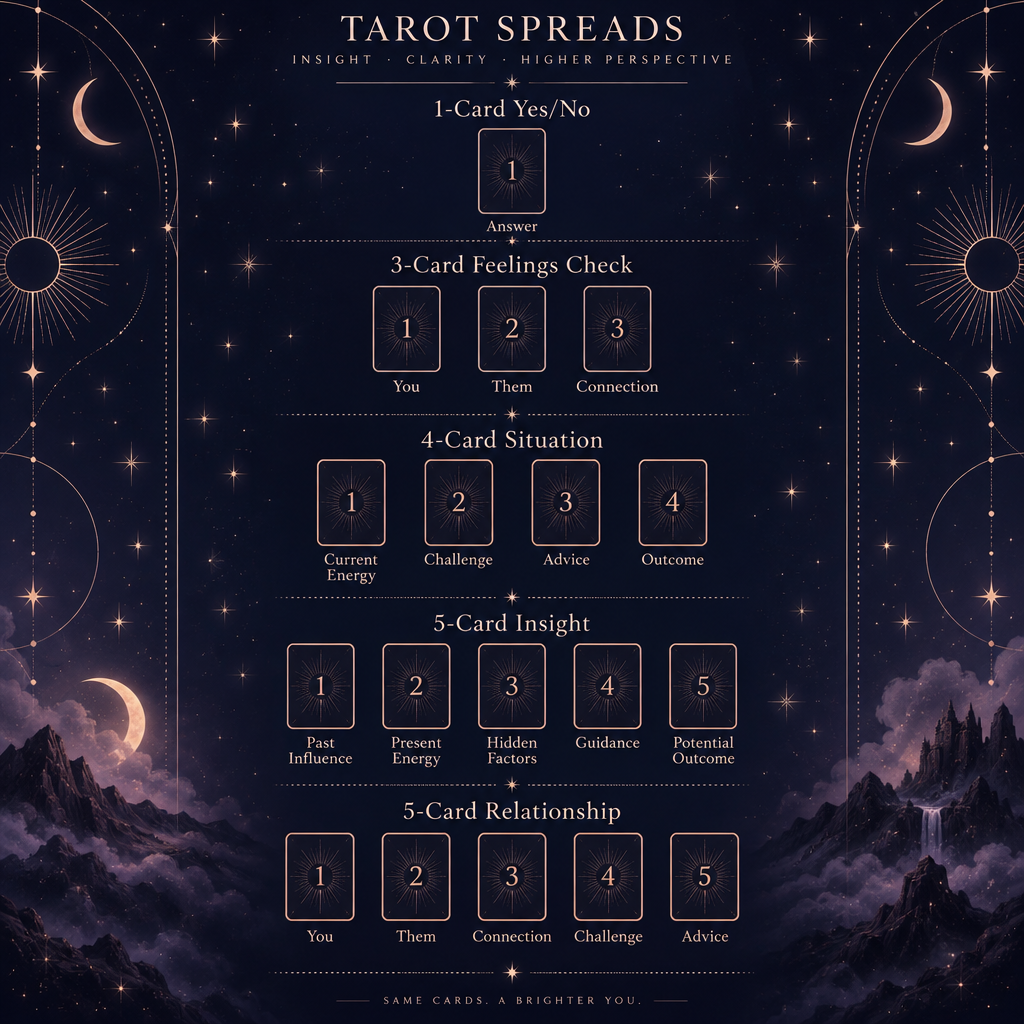
This is the fastest tool in the kit and the one most people reach for first. Shuffle, focus on a single yes/no question, cut the deck, and turn one card. It takes under a minute, which is exactly why you should treat it with some care.
How to read it
Most readers assign each card a lean rather than a hard verdict. Upright Cups and Pentacles usually lean yes. Swords lean no or “not yet.” Wands are a conditional yes that depends on your effort. The Major Arcana are strong signals either way. If you want a single reference for all 78 cards, a full tarot yes no guide saves you from guessing on the obscure ones, but the table below covers the cards that show up most in love pulls.
| Card | Lean | What it usually means in a love question |
|---|---|---|
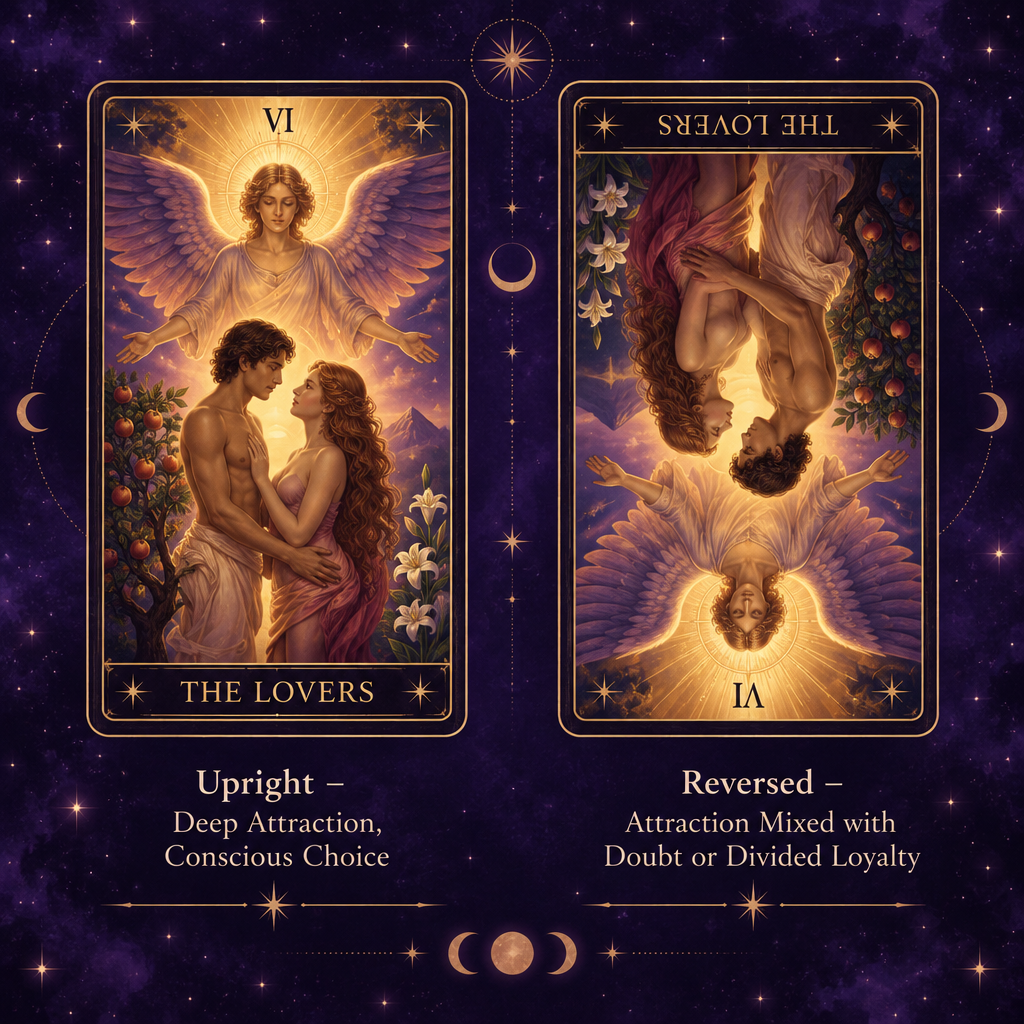
| The Lovers | Yes | Mutual pull, a real choice in front of you |
| Two of Cups | Yes | Reciprocated feeling, partnership energy |
| Ten of Cups | Yes | Lasting emotional fulfilment |
| Ace of Cups | Yes | A new emotional opening |
| Knight of Cups | Yes | A romantic offer or gesture arriving |
| The Sun | Yes | Clarity, warmth, nothing hidden |
| The Star | Yes | Hope that’s justified, healing after hurt |
| Four of Wands | Yes | Celebration, stability, often commitment |
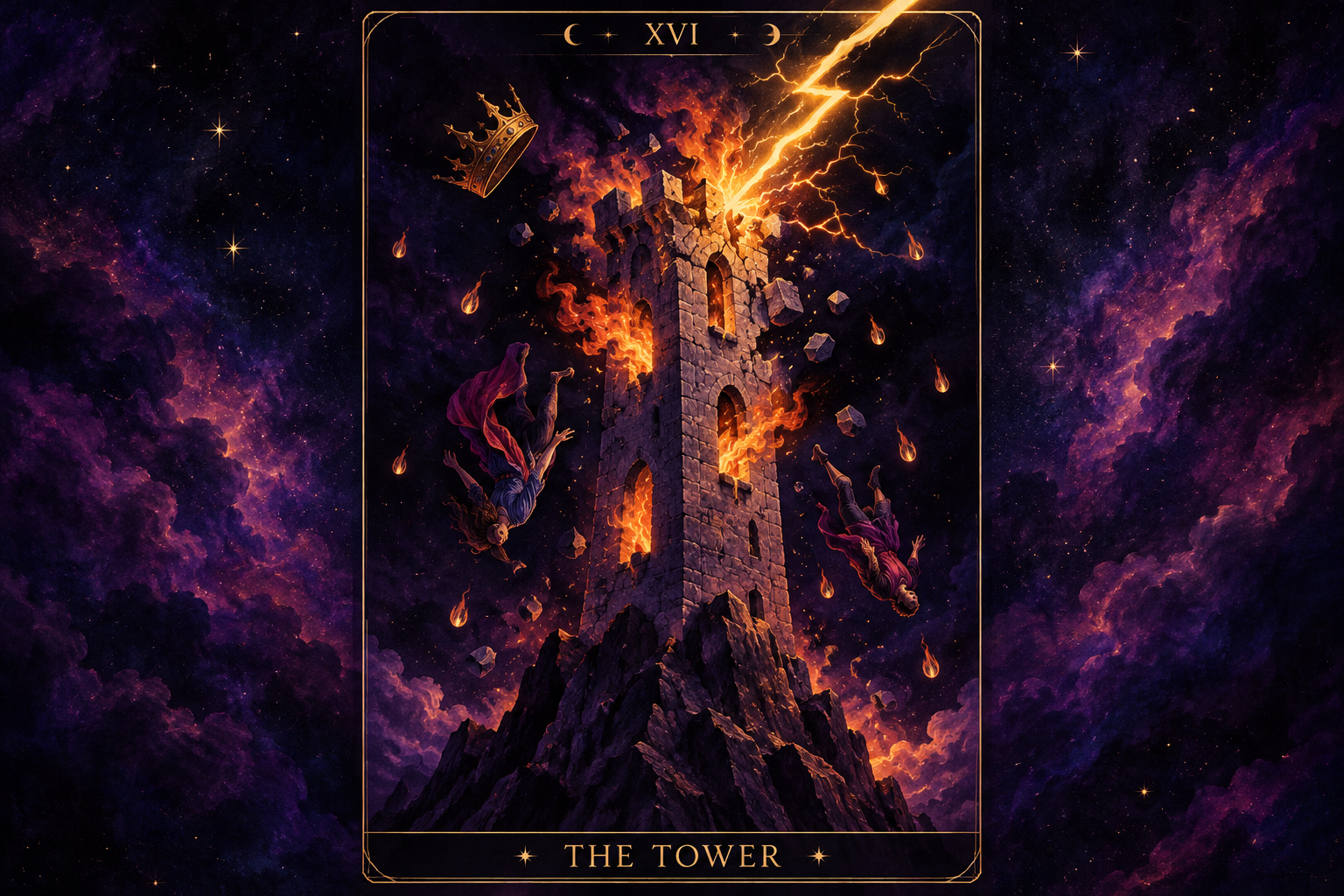
| The Tower | No | Sudden upheaval; the foundation won’t hold |
| Three of Swords | No | Heartbreak, a painful truth |
| Five of Cups | No | Grief over what’s lost, focus stuck on the past |
| Eight of Cups | No | Someone walking away to find more |
| Eight of Swords | No | Feeling trapped; the block is self-imposed |
| Five of Swords | No | A hollow win, conflict with lasting damage |
| The Devil | No | Attachment, obsession, unhealthy pattern |
| The Hermit | Not yet | A period of solitude first |
| The Hanged Man | Not yet | Suspension; nothing moves right now |
| Two of Swords | Unclear | A stalemate; you’re avoiding the decision |
| The Moon | Unclear | Illusion, mixed signals, hidden information |
| Wheel of Fortune | Maybe | Change is coming, direction uncertain |
Two cards from that list deserve a closer look because they’re so often misread. The Eight of Cups looks grim, but the figure walking away is choosing something better, which can be an honest answer to “should I stay.” The eight of cups yes or no reading is a “no” to the current situation and a “yes” to your own growth. Likewise, the eight of swords yes or no lean is a no, but the woman in the card is loosely bound and could step free. The block is real; it’s also removable.
Sample questions for a one-card pull
- Is this person currently interested in me romantically?
- Is reaching out this week a good idea?
- Is the energy between us the same as it was in spring?
- Will I hear from them before the month ends?
When one card isn’t enough
A single card tells you the lean, not the reason. If you turn the Two of Swords and feel stuck, you’ve learned that you’re stuck, which you already knew. That’s the moment to move to a multi-card yes or no tarot spread, where a clarifier can explain the stalemate, or to one of the layouts below. Don’t keep pulling single cards until one says what you want. Readers call that “asking until yes,” and it never ends well.
Spread 2: The Three-Card Feelings Check
This is the layout to use when you want to know where you and another person actually stand. It’s three cards in a row, read left to right, and it takes about ten minutes including the shuffle.
| Position | Question the card answers |
|---|---|
| 1. You | How you genuinely feel about this connection right now |
| 2. Them | How their current behaviour and energy present toward you |
| 3. The connection | What exists between you, and where it’s heading if nothing changes |
Reading the positions
Position 1 is often the most useful card in the spread, and it’s the one people skip past. If you ask about someone and pull the Nine of Swords for yourself, you’ve learned that anxiety is driving the question. That reframes everything that follows.
Position 2 needs a disclaimer that honest readers always give. The cards can’t read another person’s private mind. What they reflect is the energy they’re putting out in your direction, as you’ve experienced it. A Knight of Wands here describes someone hot, fast, and inconsistent. A King of Pentacles describes someone steady who shows affection through reliability rather than words. Both are useful. Neither is a confession.
Position 3 is where you look for the Major Arcana. The Lovers or the Sun in this spot points to a real, mutual bond. The Moon says there’s something neither of you is saying. Death says the connection as it currently exists is ending, which can be a breakup or just the end of the honeymoon phase.
Sample questions
- How does the energy currently stand between me and my partner?
- What does my friend feel toward me, as reflected in how they act?
- Where is this situationship heading over the next two months?
A worked example
Say you ask about a relationship that’s gone quiet after six good months. You pull the Four of Cups, the Eight of Pentacles, and the Temperance card.
Four of Cups for you: you’ve become bored and are overlooking what’s on offer. Eight of Pentacles for them: they’re head-down in work, focused, not withdrawn from you specifically. Temperance for the connection: patience, balance, blending two rhythms that have drifted out of sync.
That’s a reassuring reading, but notice how easy it would be to misread it. The Eight of Pentacles can look like distance if you’re already feeling neglected. Checked against its position (“their current energy”), it describes diligence, not disinterest. The eight of pentacles yes or no lean is a yes, and it’s a yes about effort, which is a different thing from a yes about romance.
Spread 3: The Four-Card Stay or Go Spread
Nobody should ask the tarot to end their relationship for them. What the cards can do is show you both sides of a decision clearly enough that you stop going in circles. This spread is built for that.
Lay two cards side by side, then two beneath them.
| Position | Question the card answers |
|---|---|
| 1. If I stay | What staying in this relationship currently offers you |
| 2. If I go | What leaving currently offers you |
| 3. What I’m not seeing | The factor you’ve been avoiding or minimising |
| 4. Advice | The most useful next step regardless of which way you lean |
How to read it honestly
Read positions 1 and 2 as neutral descriptions, not verdicts. The Ten of Pentacles in “if I stay” describes long-term security and family. The Fool in “if I go” describes freedom and a fresh start with risk attached. Neither card says “do this.” They tell you what each path looks like, and you decide which picture you want to live inside.
Position 3 is the card people flinch at. It’s often a Swords card. The Seven of Swords here suggests dishonesty somewhere, possibly your own. The Five of Swords, whose five of swords yes or no reading is a firm no, points to a fight you’d win at too high a cost. Sit with whatever lands here before moving on.
Position 4 should be read as a verb. Queen of Cups: lead with compassion. Justice: get the facts, make the fair call. The Hermit: step back and think alone before you speak.
Sample questions
- What do I need to understand about staying versus leaving this marriage?
- What am I avoiding about this relationship right now?
- What would serve me best as a next step with my partner?
A note on repeat readings
Decision spreads tempt people to re-draw until the answer changes. Give it at least a week before asking the same question again. If the cards keep returning to the same theme, they’re not being stubborn; you are.
Spread 4: The Four-Card Single and Searching Spread
Most love spreads assume you’re asking about a specific person. This one is for the stretch when there isn’t one yet and you want to know what’s in the way. It reads more like a coaching session than a prediction.
| Position | Question the card answers |
|---|---|
| 1. The block | What is currently standing between you and the love you want |
| 2. Release | What you need to let go of, a belief, a habit, or a person |
| 3. Focus | What to put your energy into over the coming weeks |
| 4. What’s approaching | The quality of connection moving toward you if you do the work |
Reading the positions
Position 1 is rarely about the dating pool. It’s usually a card about you: the Eight of Swords (you’ve talked yourself into being stuck), the Five of Cups (you’re still grieving someone), the Four of Pentacles (you’re guarding yourself so tightly nobody can get in).
Position 2 pairs with position 1. If the block is the Five of Cups, the release card often names what you’re mourning. The Knight of Cups reversed here is a classic: let go of an idealised version of someone who never fully showed up.
Position 3 is practical. Three of Pentacles: build something with other people, join the class, say yes to the group dinner. Nine of Pentacles: invest in your own life until it’s full enough that a partner adds to it rather than fills it.
Position 4 describes a type of energy, not a person with a name and a job title. The King of Cups here means a mature, emotionally fluent partner. The Page of Wands means someone playful and new. Treat it as a description of what fits you, not a face to look for.
Sample questions
- What’s currently blocking me from meeting someone compatible?
- What do I need to release before my next relationship?
- Where should I focus to make space for love this season?
Spread 5: The Five-Card Relationship Spread
This is the full picture, and it’s the layout to use when you’re in a relationship and want to understand its shape rather than answer a single question. Five cards is the ceiling for a reason. Beyond this, position meanings start overlapping and the reading loses its edges.
Lay cards 1 and 2 side by side, card 3 above them, card 4 below, and card 5 to the right.
| Position | Question the card answers |
|---|---|
| 1. You | Your role, energy, and current state in the relationship |
| 2. Them | Their role, energy, and current state in the relationship |
| 3. What unites you | The shared ground, the glue, the thing that works |
| 4. What challenges you | The friction point, the pattern that keeps causing trouble |
| 5. Likely outcome | Where the relationship heads if the current pattern continues |
How the positions talk to each other
Read 1 and 2 as a pair first. Two court cards of the same suit suggest you’re more alike than you think. A Cups card facing a Swords card suggests one of you leads with feeling and the other with logic, and position 4 will probably confirm that’s where the arguments start.
Position 3 is the card to protect. If it’s the Ten of Cups, you have deep emotional compatibility and should guard it. If it’s the Three of Pentacles, you work well as a team and might be stronger as partners-in-projects than as romantics, which is still a real bond.
Position 4 is the card to act on. The Five of Wands means competition, both of you needing to be right. The Seven of Cups means fantasy, one of you in love with a version of the other that doesn’t exist. The Four of Swords means exhaustion; you’re both too tired to do the work.
Position 5 answers “if nothing changes.” That caveat matters. A Three of Swords outcome isn’t a sentence; it’s a forecast based on the pattern in position 4. Change the pattern, change the forecast. That’s the whole point of asking.
A worked example
A reader asks about a two-year relationship that feels stuck. The cards fall: Queen of Pentacles (you), Knight of Swords (them), Two of Cups (unites), Four of Swords (challenges), Judgment (outcome).
You’re the Queen of Pentacles: nurturing, practical, building a home. They’re the Knight of Swords: fast, direct, restless, maybe blunt to the point of cutting. The Two of Cups says the underlying bond is genuine and mutual. The Four of Swords names the problem: you’re both depleted, and rest has become avoidance.
Judgment as the outcome is a strong card. The judgment tarot yes or no reading leans yes, but it’s a yes with conditions: a reckoning, a clear-eyed assessment, a call to rise to something. For this couple, it reads as a conversation they’ve been postponing. Have it, and the Two of Cups holds. Keep resting instead, and Judgment arrives on its own terms.
Which Spread to Use for Which Question
Picking the wrong layout is the most common beginner mistake. A five-card spread for “will he text” wastes four cards. A one-card pull for “should I leave my marriage” asks far too much of one image.
| Your situation | Best spread | Why |
|---|---|---|
| A quick yes/no about one small thing | 1. One-card pull | One question, one answer, no room to over-interpret |
| You want to know where you both stand | 2. Three-card feelings check | Separates your feelings, their energy, and the bond |
| You’re deciding to stay or leave | 3. Four-card stay or go | Shows both paths and the blind spot, leaves the choice to you |
| You’re single and frustrated | 4. Four-card single and searching | Focuses on your blocks and next moves, not on a stranger |
| You’re coupled and want the full picture | 5. Five-card relationship | Maps both people, the glue, the friction, and the trajectory |
If you want a more structured yes/no with clarifiers rather than a single card, a dedicated tarot love yes or no spread sits between options 1 and 2 on that table. It’s a good step up when a single card keeps landing on the Moon.
Reversed Cards in Love Readings
Reading reversals is optional, and many excellent readers skip them. In love spreads, though, reversals earn their keep, because so much of what goes wrong in relationships is a good quality turned inward or blocked.
The Lovers reversed: a choice you’re avoiding, or values out of alignment. Two of Cups reversed: a bond that’s become one-sided. The Empress reversed: smothering, or self-neglect. Knight of Cups reversed: romantic words without follow-through.
If you don’t want to read reversals, flip every card upright and treat the “challenges” position in spreads 3, 4, and 5 as the place where the shadow side shows up. You’ll lose a little nuance and gain a lot of clarity.
Questions Not to Ask
A few question types reliably produce bad readings, and a couple of them raise fair ethical concerns.
Don’t read for a third party’s private life. “Is my ex happy with her new boyfriend” isn’t your business, and the cards will reflect your feelings about the situation rather than anything about her. Keep the focus on you and on connections you’re actually part of.
Don’t ask the same question in six different wordings in one sitting. You’re not getting six readings; you’re getting one answer and five attempts to overrule it.
Don’t ask for exact timing. “When will I meet someone” invites a Knight or a number card that you’ll convert into “within three months” and then feel betrayed by. Ask “what’s the next step toward meeting someone” instead and you’ll get something you can do.
And don’t read when you’re in the first hour of a crisis. Shuffle after the panic has passed, not during it. The cards will still be there.
A Simple Ritual to Keep the Reading Clean
You don’t need candles or a special cloth. You do need a repeatable process, because the ritual is what keeps you from skipping steps when you’re emotional.
Write the question down before you shuffle. Reading it back often shows you that it’s really two questions or that it’s phrased as a plea.
Shuffle until your hands feel done, then cut once. Lay all the cards before you read any of them. Reading as you go means card one colours how you see card two.
Read each card against its position first, then against the others. Write the spread down with the date. Three months later, reading your old notes is the fastest way to learn how your deck talks to you.
FAQ
What’s the most accurate tarot spread for love questions?
Accuracy depends more on the question than the spread. For a single clear question, the one-card pull is hard to beat. For understanding a relationship, the five-card spread gives the fullest picture without blurring. Three cards is the sweet spot for most people.
Can tarot tell me how someone else feels about me?
It can reflect the energy and behaviour they’re currently directing toward you, as you’ve experienced it. It can’t read their private thoughts. Treat the “them” position as a description of what they’re showing you, not a confession of what they’re hiding.
How often should I do a love reading?
For the same question, wait at least a week, and ideally wait until something has actually changed. Daily pulls on different questions are fine. Daily pulls on the same ex are a sign to put the deck down and call a friend.
Which cards are a clear yes for love?
The Lovers, Two of Cups, Ten of Cups, Ace of Cups, the Sun, the Star, and Four of Wands are the strongest yes cards in a love context. The Knight of Cups is a yes about a gesture or offer arriving.
Which cards are a clear no?
The Tower, Three of Swords, Five of Cups, the Devil, Eight of Swords, Five of Swords, and Eight of Cups lean firmly no. Several of them, especially the Eight of Cups and Eight of Swords, are “no” to the current situation and “yes” to your own next step.
Should I use reversed cards for love spreads?
Use them if you’re comfortable with them. They add nuance about blocked or distorted feelings. If reversals confuse you, read everything upright and let the “challenges” position carry the shadow side of the reading.
Do I need a specific deck for love readings?
No. Any 78-card deck with clear suit imagery works. Decks built on the Rider-Waite-Smith system, first published in 1909, are the easiest to learn because the Minor Arcana are fully illustrated, so a card like the Five of Cups shows its grief instead of five identical cups.